
Are you looking for a flexible, budget-friendly phone plan in Japan? If you're comfortable with Japanese and don't use much data, you might consider povo—a customizable plan from au that lets you pay only for what you need.
There's no monthly base fee, and you can buy data "toppings" as required, making it suitable for light users. However, it's worth noting that the app is in Japanese, cutomer service is limited, and if you forget to purchase data, you'll be left with a very slow 128 Kbps connection.
This guide will explain how povo works, its real-world costs, and the frustrations reported by users on Reddit. We'll also compare povo with options like Sakura Mobile, which offers English support and simple pricing for non-Japanese speakers.
Let's see if povo fits your needs in Japan.
Povo Plans Overview
Povo (officially called "povo2.0") is au's online-only mobile service with no monthly fee. Instead, you buy "toppings"—add-ons for data, calls, and more—only when you need them.
Here's what you need to know about povo's structure:
| Feature | Details |
| Base Monthly Fee | 0 yen/month |
| Network | au's 4G/5G Network (99% coverage across Japan) |
| Plan Types | Voice + Data Plan (physical SIM or eSIM) OR Data-Only Plan (eSIM only) |
| Contract Period | None (cancel anytime) |
| Admin/Setup Fee | None |
| Tehtering/Hotspot | Available |
| Overseas Roaming | Available in 160+ countries and regions (must buy overseas data topping) |
| Domestic Usage Fees | Calls: 22 yen/30 seconds (tax included) Sending SMS: 3.3 yen/message Receiving SMS: Free |
Important note: Without purchasing any toppings, your base speed is capped at 128 Kbps—barely enough for basic messaging. We'll explain what that really means below.
How Povo's Topping System Works
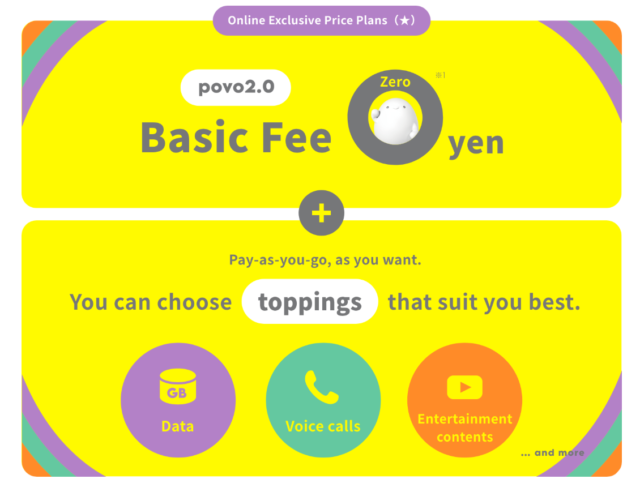
Instead of paying a fixed monthly fee like other carriers, povo lets you buy data in chunks called "toppings." Each topping ives you a set amount of data and an expiration date. When your data runs out or your time expires, you revert to 128 Kbps until you buy another topping.
Popular Data Toppings (as of November 2025):
| Topping | Price (tax included) | Validity Period |
| 1 GB | 390 yen | 7 days |
| 3 GB | 990 yen | 30 days |
| 30 GB | 2,780 yen | 30 days |
| 60 GB | 6,490 yen | 90 days |
| 150 GB | 12,980 yen | 180 days |
| Unlimited (24 hours) | 330 yen | 24 hours from purchase |
| Unlimited (6 hours) | 250 yen | 6 hours from purchase |
Call Toppings:
| Topping | Price (tax included) |
| Unlimited calls (under 5 minutes each) | 550 yen/month |
| Unlimited calls (any length) | 1,650 yen/month |
| Voicemail service | 330 yen/month |
Note: Standard pay-per-use calling is 22 yen per 30 seconds without a call topping.
Voice + Data vs. Data-Only Plans
Voice + Data Plan:
- Can make and receive phones calls and SMS.
- Available as a physical SIM or eSIM.
- Requires ID verification (residence card, My Number card, etc.).
- You can transfer your existing phone number (MNP).
Data-Only Plan:
- eSIM only (no physical SIM option).
- No phone calls or SMS capability.
- No ID required, but you need a separate phone number to receive SMS verification during signup.
- Must be 18 years or older.
- You must purchase an initial topping when signing up, with prices starting at 330 yen for 24-hour unlimited data.
The 180-Day Rule You Need to Know
Here's something that catches people off guard: if you don't purchase any toppings for 180 consecutive days, povo will suspend your account.
How to keep your account active:
- Buy at least one data topping within 180 days, OR
- Make at least 30 minutes of pay-per-use calls (which cost around 660 yen total)
Why this matters: Some people use povo as a backup SIM with the zero-yen base plan, but you can't leave it inactive. You need to spend at least 330 yen (for 24-hour unlimited pass) every six months to keep your line active.
What Does 128 Kbps Actually Feel Like?
Without a topping, povo's base speed is capped at 128 Kbps. Here's what you can—and can't—do at that speed:
✅What works:
- Sending/receiving text messages (LINE, WhatsApp).
- Very basic web browsing (expect 30+ second load times).
❌What doesn't work:
- Google Maps (takes forever to load, won't update in real time).
- Social media (Instagram, Facebook, Twitter won't load images properly).
- Video streaming (forget it).
- Email with attachments (painfully slow).
Real talk: 128 Kbps is essentially unusable for anything beyond basic messaging. You'll need WiFi or a data topping to actually use your phone.
Auto-Charge Feature
Povo offers an "auto-charge" feature that automatically buys the same topping when your current one runs out or expires. You can turn this off or on after purchasing any topping.
Pros: Never get caught without data.
Cons: Can rack up charges if you forget it's enabled.
Povo Data Oasis: Free Data at Lawson
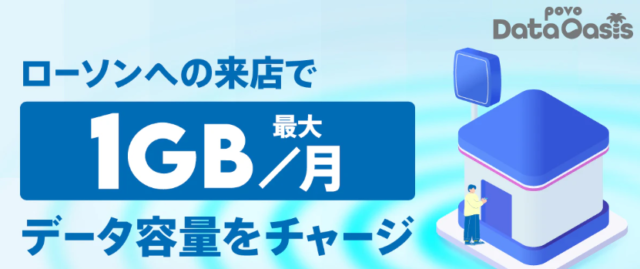
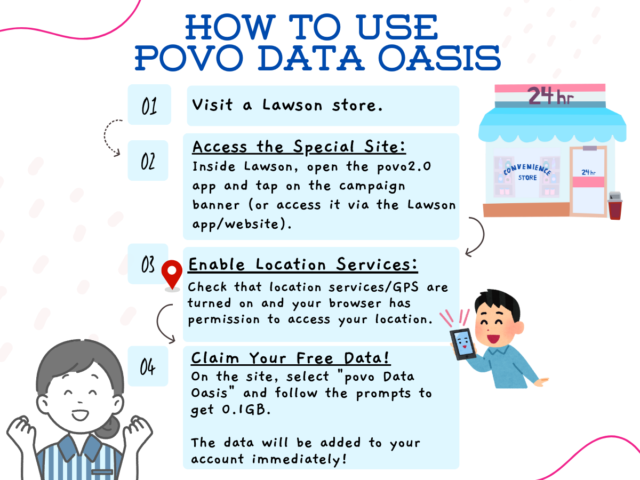
Povo has a partnership with Lawson convenience stores called "povo Data Oasis," letting you get free data just by visiting.
- What you get: 0.1 GB (100 MB) per visit
- Limit: Once per day, up to 10 visits per month (1 GB total free data monthly)
- How it works: Open the povo app at a Lawson, and the data is automatically added.
Povo also runs limited-time collaboration campaigns with Lawson, like "Giga Charge Card: Unlimited Data for 24 hours for 330 yen," or combo deals with Sushiro restaurant vouchers.

Wondering which mobile carrier has the best coverage in Japan?📱
Read our in-depth guide comparing NTT docomo, SoftBank, and au here.
Advantages of Using Povo

Povo offers genuine benefits that appeal to certain users. Here's what works:
1. True Flexibility (If You're a Light User)
The biggest selling point is the pay-as-you-go structure. If you barely use mobile data because you're always on WiFi, povo can save you money. You only buy data when you actually need it—no wasted monthly fees for data you never use.
Real-world scenario: You work from home wiht fiber itnerent asnd only need mobile data occasionally when you're out. Buy a 1 GB topping for 390 yen when you need it, and you're done.
2. No Contract Commitment
Unlike traditional carriers that lock you into contracts, povo has no contract period and no cancellation fees. You can stop using it at any time without penalty. However, please keep in mind that you are still obligated to pay the topping usage charges, universal service charges, and call relay service charges used up until the time of cancellation.
The catch: Remember the 180-day rule—if you don't buy toppings or make calls for six months, your acount gets suspended anyway.
3. Reliable au Network
Povo runs on au's 4G/5G network, which covers 99 percent of Japan. The connection quality is solid—same network as au's premium plans, but at lower prices.

📱Insider Tip: You can use povo to keep a cheap, secondary line just in case (with topping up every 6 months) to maintain your SIM if you travel or go abroad.
Sakura Mobile offers a suspend option, which allows you to temporarily pause your plan while keeping your phone number for just ¥220/month!
4. Cost-Effective Unlimited Calling
At 1,650 yen per month for truly unlimited calls, povo's call topping is one of the cheapest among major carriers in Japan. If you make a lot of voice calls (not just LINE calls), this is a good deal.
5. Good for Secondary "Emergency" Line
Some people use povo as a backup SIM—just buy the cheapest topping (330 yen for 24-hour unlimited data) at least once every six months to keep the number active. It's a simple way to keep a second phone number handy.
Interested in what plans au has to offer?
Check out our Guide to au Plans
Disadvantages of Using Povo

Now for the problems—and there are several that make povo frustrating for many long-term international residents.
1. Basically Unusable Without Buying Toppings
The 128 Kbps base speed is so slow it's essentially unusable. You can't rely on it for navigation, checking social media, or anything beyind basic text messages. If your topping expires and you forget to buy a new one, you're stuck.
Reddit reality check: Users on r/japanlife frequently complain about this. If you're out and your topping expires, you need WiFi to access the povo app to buy more data. It's a frustrating catch-22.
2. Data Expires—No Rollover
Every topping has an expiration date. Buy 3 GB for 30 days, but only use 1 GB? Unfortunately, the remaining 2 GB disappears when the 30 days are up. There's no rollover or refund.
Compare this to Sakura Mobile, which lets you roll over unused data to the next month, so you can use it later instead of losing it.
3. App-Only Management (And the App Has Problems)
Everything must be done through the povo2.0 app—buying toppings, checking usage, and managing your account. There are no physical stores, and the website just redirets you to download the app.
The problem: Google Play reviews mention recurring issues with app crashes, screens freezing during signup, and loading failures. One user said, "Terms of service can't be loaded—just a frozen black and white screen. I couldn't sign up at all." If the app malfunctions, you have no other way to manage your service.
If the app malfunctions, you have no other way to manage your service.
Cell phone plans can be tricky to navigate—whether it's signing up, understanding contracts, or troubleshooting—especially when everything is in Japanese. With Sakura Mobile, you'll get full English support every step of the way, making it effortless to manage your plan, top up data, and solve any issues hassle-free! 💓
4. Almost No English Support
This is the biggest issue for international residents. The app, website, and customer service—everything is in Japanese.
Povo's official stance is that they "may be able to guide you in English if you send screenshots via chat," but the cat itself is in Japanese, operates only from 9 AM-9 PM, and userse report difficulty getting help.
Google Play reviews confirm this frustration: "Please provide English app support. I can auto translate on the website but not in the app..."
5. Customer Service is Limited and Online-Only
Like we mentioned above, chat support is only available 9 AM-9 PM. If your SIM stops working at 10 PM or on a holiday, you're on your own until the next business day.
Multiple reviewers on Google Play mention: "Customer service nowhere to be found. Overall bad experience."
6. Credit Card or Paidy Payment Only
Povo only accepts credit cards and Paidy for payment—no bank transfers, no convenience store payments, no other options. If you don't have a Japanese credit card or access to a Paidy account, this can be a barrier.
Who Should Use Povo (and Who Shouldn't)?

After looking at the pros and cons, here's who povo actually makes sense for—and who should look elsewhere.
Povo Works Well If You:
- Use very little mobile dataYou're on WiFi most of the time and only need data occasionally.
- Are fluent in JapaneseYou need a second phone number and don't mind buying the 330 yen topping every six months.
- Want a cheap backup lineYou need a second phone number and don't mind buying the 330 yen topping every six months.
- Have flexible data needsSome months you need a lot, some months you need almost nothing.
Skip Povo If You:
- Need English SupportThe app, website, and customer service are all in Japanese or only partially in English.
- Use mobile data regularlyHaving to buy toppings and watching expiration dates gets old fast.
- Want simple, predictable billingPay-as-you-go sounds flexible until you're constantly checking your data.
- Need customer service outside business hoursChat support only runs 9 AM-9 PM.
- Prefer in-person helpPovo is app-only with no physical stores.
The reality: Most long-term international residents find povo frustrating. With a Japanese-only interface, data that expires with no rolllover, and a super slow base speed, it's a hassle—especially when English-friendly alternatives like Sakura Mobile exist.
📌Looking for an affordable phone plan as a student in Japan? Check out our guide to Japanese Cell Phone Plans for Students to find the best option for you!
Comparison with Other Carriers
How does povo stack up against other options for long-term residents in Japan? Here's a realistic comparison:
Povo vs. Major Competitors
| Carrier Name | Monthly Fee & Data (Tax incl.) | Network | Coverage | English Support |
| povo | From 1 GB: 390 JPY to 360 GB: 26,400 JPY | au | ~99% | Very limited |
| ahamo | 30 GB: 2,970 JPY | docomo | ~99% | Japanese Only |
| au | 3 GB: 5,665 JPY Unlimited: 7,458 JPY | au | ~99% | Very limited |
| SoftBank | 3 GB: 5,478 JPY Unlimited: 7,425 JPY | SoftBank | ~99% | Very limited |
| Sakura Mobile | 5 GB: 3,278 JPY 30 GB: 4,378 JPY 40 GB: 5,478 JPY | docomo | ~99% | Full English support |
(All prices include tax)
Why These Numbers Matter
If you use 3 GB per month with povo: 990 yen
If you use 5 GB per month with povo: You'd need two toppings =~1,380 yen (1 GB + 3GB, every 7-30 days).
Sounds cheap, right? But remember:
- Data expires whether you use it or not.
- No rollover.
- 128 Kbps when you run out.
- Everything in Japanese.
Compare to Sakura Mobile at 3,278 yen for 5 GB:
- Fixed monthly price—no surprises.
- Unused data rolls over to the next month, so you don't lose it.
- Full English support via email, contact form, phone, and visiting thier Tokyo office.
- Comes with a Japanese phone number for 2FA codes.
- No 180-day suspension rule to worry about.
Yes, it costs more than povo's cheapest option. But you're paying for peace of mind and support in your language.

The ahamo Alternative
Man people compare povo to ahamo since both are online-only budet plans from major carriers.
Here's the key difference:
Ahamo gives you fixed 30 GB for 2,970 yen—predictable and straightforward, and includes 5 minutes of free domestic calling. If you use 3 GB or more per month, ahamo is a better value than povo.
The problem: ahamo is also Japanese-only for support, and the application process can be tricky for international residents.
What Makes Sakura Mobile Different
Sakura Mobile is designed for international residents who want reliable service and full English support. Here's what you get that povo doesn't offer:
- Full English Support– Website, customer service, billing—all in English.
- Data rollover – Unused data carriers over to the next month, so you don't lose it.
- Suspend option – Pause your plan for 220 yen per month when traveling, and keep your number.
- No activation hassles – Works with a passport or a residence card, no credit checks.
- Same-day response – Contact form support usually replies within 24 hours.
- Option to top up data – Need more? Add data without changing plans.
Real-world scenario: You're new to Japan, you don't speak much Japanese yet, and your SIM suddeny stops working. With povo, you're stucl with a Japanese chatbot and no support. With Sakura Mobile, you can use the contact for or call in English and get fast help. That peace of mind is worth the price difference for most international residents.
Quick Guide to Start the Service
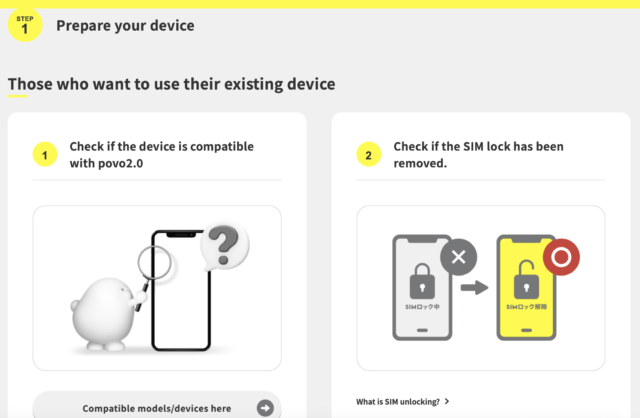
Here's the simplified process for signing up with povo (note: everything is in Japanese or vague, machine translated English):
What You Need:
- Unlocked smartphone (SIM-free device required)
- Residence card or My Number card (for voice + data plan; not needed for data-only)
- Credit card or Paidy account required.
- WiFi connection rquired for setup.
Basic Steps:
- Download the povo2.0 app.
- Select your plan type (Voice + Data or Data-Only).
- Upload your ID and set up payment.
- Choose physical SIM or eSIM.
- Purchase your first topping (required for data-only plans).
- Activate your SIM following the in-app instructions.
Important notes
- eSIM activation is available according to the app instructions. You should complete the setup during regualr business hours for support.
- You'll need a second device (computer or tablet) to scan QR codes for eSIM setup.
- Check povo's device compatibility list before applying.
For detailed step-by-step instructions with screenshots, visit the povo activation guide (in Japanese with some English).
FAQ

- Do I have to purchase a device from povo?
No, povo doesn't sell phones or devices. You need to bring your own unlocked smartphone. Povo recommends buying devices from the au Online Shop if you need one, but you can use any SIM-free phone that's compatible with au's 4G or 5G network.
- Does my phone need to be unlocked?
Yes. Your device must be SIM-unlocked (SIM-free) to use povo. Phones purchased from au don't need unlocking, but devices from other carriers—docomo, SoftBank, overseas carriers—must be unlocked first.
- Can I use povo if I don't speak Japanese?
Technically, yes, but it isn't easy. The app, website, and customer service are all in a mixture of Japanese and awkward, machine-translated English. Povo says they "may be able to guide you in English if you send screenshots," but the chat interface itself is in Japanese. If you're not comfortable with Japanese, this will be frustrating.
- What payment methods does povo accept?
Credit cards and Paidy only No bank transfers and no convenience stores payments.
- Can I keep my current phone number?
Yes, you can stransfer your number using MNP (Mobile Number Portability). You'll need to get an MNP reservation number from your current carrier first.
- What happens if I run out of data?
Your speed drops to 128 Kbps until you buy another topping. At that speed, you can barely send text messages—forget about maps, social media, or browsing.
- Is povo's eSIM different from thier physical SIM?
Functionality, they're the same for the Voice + Data plans, but an eSIM requires a compatible device and a WiFi connection to set up. Data-only plans offer only eSIMs—there's no physical SIM option for data-only users.
FAQ
Choose Sakura Mobile for Better English Support

Povo offers a flexible, pay-as-you-go model that can work well for Japanese speakers who use very little mobile data. The zero-yen base fee sounds attractive, but the reality is more complicated: data expires without rollover, the base speed is unusable, and everything mut be managed through a Japanese-only app.
For long-term international residents in Japan, the lack of English support is the biggest barrier, When your SIM stops working, or you need help with billing, navigating Japanese-only chat support with limited availability can be stressful.
If you value peace of mind and want a service designed for English speakers, consider Sakura Mobile instead.
Why Choose Sakura Mobile? 🌸
- Full English support – Website, customer service, and billing are all in English.
- Data rollover – Unused data carries over to next month (up to 1 month).
- Simple pricing – No topping confusion, no expiration dates to track.
- Same-day response – Use the support form or call for help in English anytime.
- Suspend option – Keep your number for just 220 yen/month when traveling.
- docomo's reliable network – Same 99% coverage, same fast speeds.
Voice + Data Plans start fom 3,278 yen per month (tax included) for 5 GB with voice and data on Japan's biggest network.
👉Check out Sakura Mobile's monthly plans here
Don't stress over Japanese-only apps and expiring data. Get a phone plan that actually supports you in English—from signup to daily use.