
Whether you're climbing Mount Fuji or riding the train for hours between stops, staying connected makes the trip easier. You'll want it for maps, translation apps, and reaching your hotel.
- Comparing docomo, SoftBank, and au
- docomo vs SoftBank: Which is More Reassuring for Rural Travel?
- au vs docomo: Wider Coverage or a Balance of Both?
- SoftBank vs au: Which is Easier for City-Focused Trips?
- Popular Destinations in Japan: Connectivity by Area
- For a Japan eSIM, Check the Network It Runs On
- International Roaming vs SIM vs eSIM vs Pocket WiFi
- Why Travelers Choose Sakura Mobile
- Frequently Asked Questions
- Conclusion: Don't Leave Connectivity to Chance

Tired of sky-high roaming charges? Take a look at Sakura Mobile's travel SIM, eSIM, and Pocket WiFi plans.
Comparing docomo, SoftBank, and au
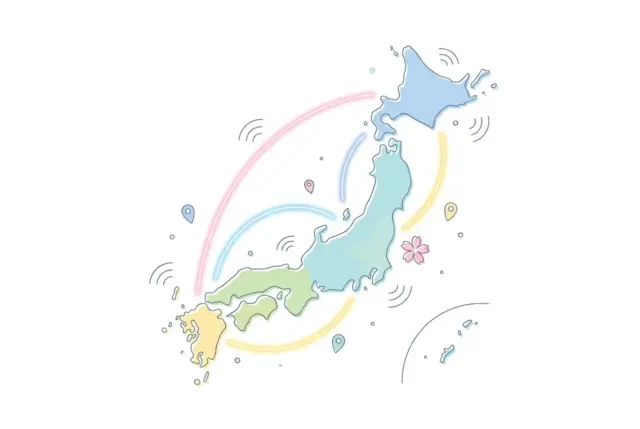
All three carriers cover most of Japan, but how well you connect in rural areas and busy tourist spots depends on where you go and how you get there. If you want fast data, it's also worth checking 5G coverage.
Sakura Mobile is an MVNO. Its 5G plans run on either the docomo or au networks. You get English customer support and no long-term contract, which makes it an easy choice for travelers.
Here's a quick look at how the three big networks compare.
| Feature | docomo (used by Sakura Mobile) | SoftBank | au by KDDI (used by Sakura Mobile |
|---|---|---|---|
| Overall Coverage | ✅ Best nationwide: 99% of the population | ✅Good for city use | ✅ Good for city use |
| Rural Coverage | ✅ Widest reach; with a strong signal even in remote areas | ⚠️ Limited in rural areas | ✅ Expanding coverage in rural areas |
| 5G Availability | ✅ Widely available nationwide, in about 70% of areas | ✅ Expanding in cities | ✅ Expanding in cities and rural areas |
| Subway/Underground | ✅ Stable in most areas, with top-tier underground coverage | ✅ Handy on the Tokyo subway | ✅ Solid coverage in major areas |
| Mt. Fuji Coverage | ✅ Full LTE during climbing season | ✅ Seasonal LTE | ✅ 5G available in parts of the summit during climbing season |
| Tourist Hotspot Reliability | ✅ Strong at major sights | ⚠️ Weaker in rural areas | ✅ Good coverage at popular sights |

What is an MVNO?
An MVNO (Mobile Virtual Network Operator) sells mobile service without owning its own network. Instead, it buys network access from a major carrier like docomo and resells it. That's how an MVNO can offer a reliable network at a competitive price: it sits between the big carriers and you, passing on flexible plans for less.
For trips that include rural areas, mountains, hot spring towns, remote islands, or hiking, docomo is generally the more reassuring option. SoftBank can work well for city-focused travel, while au by KDDI offers a good balance for major cities, station areas, and popular sightseeing spots.
docomo vs SoftBank: Which is More Reassuring for Rural Travel?
Among Japan's major carriers, docomo offers the widest coverage, making it the strongest choice for trips that include rural areas, mountains, coastal towns, or remote islands. In these destinations, reliable coverage matters more than achieving the fastest speeds in major cities.
By comparison, SoftBank performs well in major cities, like Tokyo, Osaka, and Nagoya. However, in mountainous regions, rural areas, or while traveling between cities, coverage may be less consistent than docomo's.
This is especially noticeable in places like Hokkaido, where towns are far apart, or mountain villages such as Tsumago and Magome along the historic Nakasendo Trail. In these areas, a reliable signal helps you check maps, contact your accommodation, monitor the weather, and stay connected if your travel plans change.
On trips like these, wide coverage is more reassuring than city speed. That's why Sakura Mobile offers SIM and eSIM plans that run on the docomo network.
If you are still deciding which option fits your trip, start with our guide to choosing the best SIM card in Japan. Travelers who want a quick digital setup can compare Sakura Mobile's eSIM options, while those traveling with multiple devices may find Pocket WiFi more convenient.
au vs docomo: Wider Coverage or a Balance of Both?
au is the mobile brand from KDDI and one of Japan's three major mobile networks. It offers a good balance of coverage, speed, and reliability, making it a strong choice for travelers who plan to spend most of their time in major cities and popular tourist destinations.
For a typical trip through cities like Tokyo, Kyoto, Osaka, and Hiroshima, with stops near major attractions and day-trip destinations, au is a reliable network to use. It's also a good option if your phone supports eSIM, as it performs well in city centers and other busy tourist areas.
If your itinerary includes mountains, remote islands, or off-the-beaten-path destinations, it's also worth considering docomo, which generally offers wider nationwide coverage. Signal quality on the Shinkansen and local trains can also vary depending on tunnels, terrain, congestion, your device, and the route, so no single network performs best in every situation.
SoftBank vs au: Which is Easier for City-Focused Trips?
SoftBank and au are both easy choices for travelers who spend most of their time in big cities like Tokyo, Osaka, and Nagoya. If your days are filled with cafes, hotels, shopping districts, subways, and downtown nightlife, either one works.
SoftBank suits short city stays and business trips, where you rarely leave the major hubs. au leans a little broader, balancing speed and stability across city centers, station areas, big sights, and travel between cities.
If your itinerary is limited to major cities, SoftBank is a solid choice. If you're traveling between multiple cities and popular sightseeing destinations, au may be a better fit.
Popular Destinations in Japan: Connectivity by Area
Connectivity at Japan's popular destinations changes from place to place. The Tokyo subway, Kyoto's temples and shrines, Mount Fuji's climbing trails, and the forests of Nikko each behave differently when it comes to signal.
Tokyo: Stability Matters, Even in Subway and Crowds

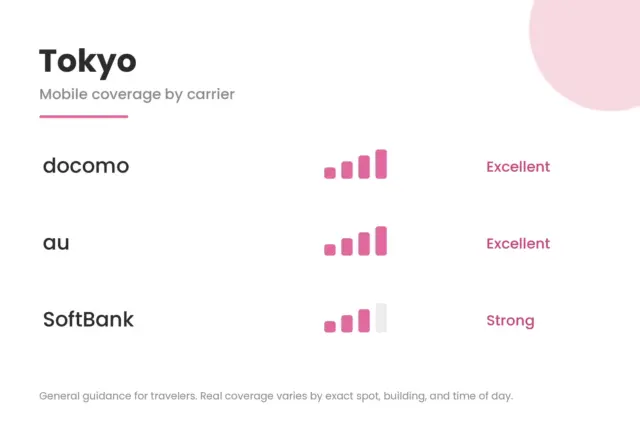
In Tokyo, all three carriers offer excellent LTE coverage, and 5G continues to expand. For travelers, the real difference is how well a network performs while you're on the move—in subway stations, crowded tourist areas, and between attractions.
Based on that, docomo and au are generally the most dependable choices thanks to their consistently strong coverage across Tokyo, including underground stations. SoftBank is also a solid option for travelers spending most of their time above ground in central Tokyo.
Kyoto: Watch the Signal Near Temples and Hillsides

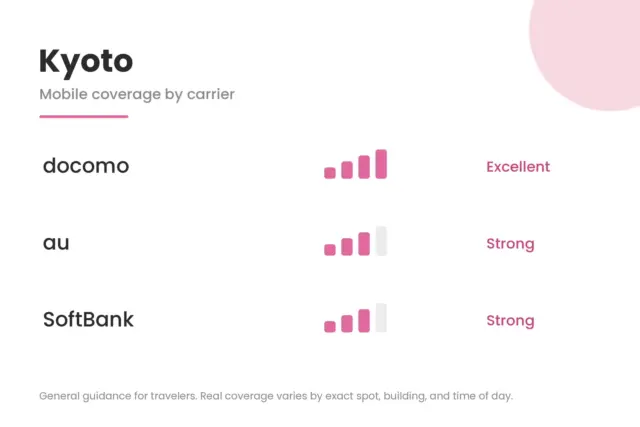
Kyoto's temples, shrines, hills and historic streets create different coverage conditions than central Tokyo. While all three major carriers perform well in the city, travelers rely on their phones for maps, buses, and messaging throughout the day.
The real difference is how well a network performs around popular attractions like Fushimi Inari, Arashiyama, Kiyomizu-dera, and the Philosopher's Path, where terrain, buildings, and crowds can affect signal quality.
Based on that, docomo is generally the most reassuring choice for Kyoto. au, and SoftBank also provide reliable coverage, especially in central Tokyo and popular sightseeing spots.
Mount Fuji: Coverage Improves in Climbing Season, with Caveats

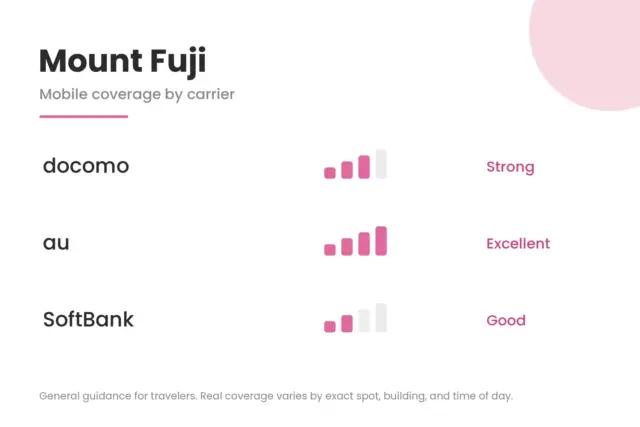
On Mount Fuji, reliable coverage is part of staying safe. Travelers rely on their phones to check the weather, confirm their route, and call for help if needed.
Coverage varies by location, weather, and the climbing season. During the official season (mid-July to late August), KDDI provides au 5G at the summit and near the Gotemba New 5th Station, with 4G LTE available at the summit, mountain, huts, trailheads, and major climbing routes.
Based on the current coverage, au is one of the strongest choices for climbing Mount Fuji. Even so, check the latest coverage before you climb, as conditions and availability can change.
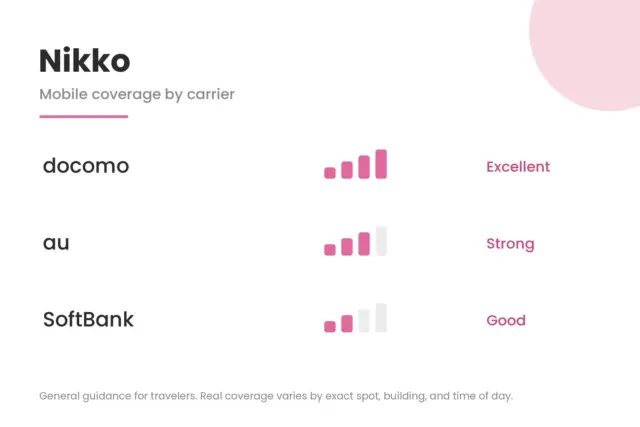
Nikko: Check Ahead in Mountain and Forest Areas

Nikko combines historic sights with mountains and forests, so reliable coverage matters for maps, navigation, and transportation. Travelers visiting Toshogu Shrine, Kegon Falls, Lake Chuzenji, and nearby hiking trails may experience different coverage conditions.
The real difference is how well a network performs beyond central Nikko, especially around Lake Chuzenji, mountain roads, and forested hiking areas where signal can be less reliable.
Based on overall coverage, docomo is generally the most dependable choice for Nikko. au also performs well around major attractions, while SoftBank is better suited to travelers staying mainly in central sightseeing areas. As with any rural destination, check your route and coverage before heading into the mountains.
Planning your Japan trip? Sakura Mobile offers travel SIMs, eSIMs, and Pocket WiFi, so you can choose the option that best fits your travel plans—from sightseeing to rural adventures.
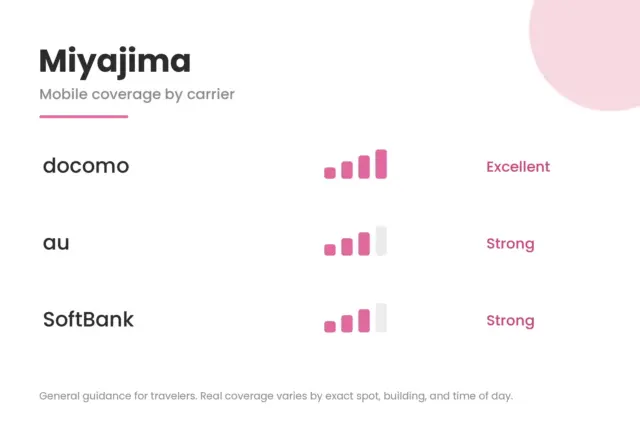
Miyajima: Easy in the Main Areas, Spotty Deeper In

Miyajima combines busy sightseeing areas with forested mountain trails. Travelers rely on their phones for maps, navigation, and transportation throughout the island.
The real difference is how well a network performs beyond the main attractions. docomo, SoftBank, and au all provide reliable coverage around Itsukushima Shrine, the ferry area, and other popular sights, but coverage can become less consistent toward Mount Misen and quieter parts of the island.
Based on overall coverage, docomo is generally the most dependable choice for Miyajima. au and SoftBank also perform well around the main sightseeing areas. If you plan to hike or explore beyond the shrine, check the latest coverage before you go.
🔗Learn more about our eSIM options.
🔗Learn more about our Pocket WiFi Plans.
For a Japan eSIM, Check the Network It Runs On
When you pick an eSIM for Japan, look past price and data. Check which Japanese network it runs on.
Two eSIMs can look the same yet connect differently in rural areas, the mountains, and tourist spots, depending on the network behind them. Both might work fine in Tokyo, Osaka, or Kyoto, then differ at a country station, a hot spring town, a hillside sight, or an island.
If your trip mixes cities and countryside, that transparency matters. The question isn't just "Which eSIM brand should I choose?" It's also, "Which network does it use, and does that fit my route?"
Sakura Mobile lists the network behind each SIM, eSIM, and Pocket WiFi option. Being able to weight the network alongside price and data is one less thing to worry about on the road.
International Roaming vs SIM vs eSIM vs Pocket WiFi
There are four main ways to stay connected, and each fits a different style of trip. Start by matching the option to your device, your group size, and your route.
| Option | Best for | Watch-outs |
|---|---|---|
| International roaming | Short stays of a few days; travelers who want to skip setup | Charges add up quickly, and it may not run as smoothly as a Japan SIM or eSIM. |
| Physical SIM | Solo travelers; itineraries that include rural areas | Your phone must be unlocked. |
| eSIM | iPhone XS or later and compatible Android phones | No physical card to pick up; install with a QR code. Check that your device supports eSIM. |
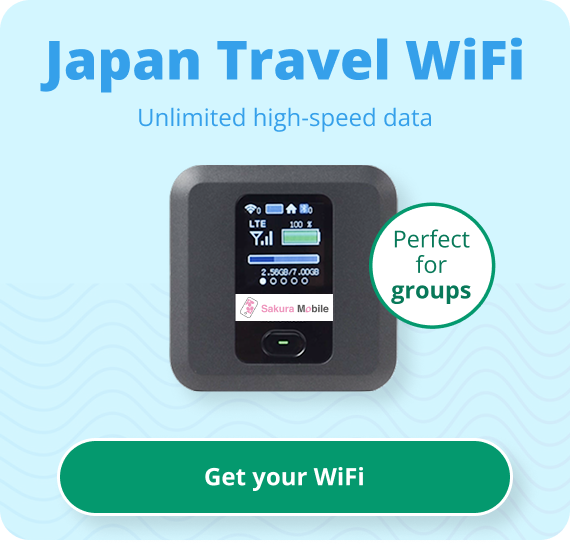
| Pocket WiFi | Group trips; travelers who want to connect a PC or tablet | Connects several devices. Mind the battery and don't lose it. |
If you're traveling solo with an eSIM-compatible phone, an eSIM is often the most convenient choice. If your phone doesn't support eSIM, a physical SIM offers the same reliable connection. For groups or travelers who want to connect multiple devices, Pocket WiFi is usually the better option.
Once you've chosen how to connect, the next thing to check is which network it uses. Skip that step and you might be fine in the city but stuck in the countryside.
Why Travelers Choose Sakura Mobile
Stay comfortably connected in Japan isn't just about the network. It's also about service that fits how you travel.
Sakura Mobile offers SIM, eSIM, and Pocket WiFi for travelers. It's an easy option if you want your connection ready before you land, or if Japanese-only sign-up and store visits make you nervous.
On top of prepaid plans with no long-term contract, you can pick up at the airport, get delivery to your hotel, or have it sent to an address you choose, all built around short stays.
Match Your Network and Device to Your Itinerary
Sakura Mobile offers SIM, eSIM, and Pocket WiFi for visitors to Japan, and it lists the network behind each one.
The best option depends on your trip. If you're heading into rural or mountain areas, reliable coverage and steady service are key. If you're visiting cities like Tokyo, Kyoto, and Osaka with an eSIM-compatible phone, an eSIM offers a convenient way to get connected for groups or travelers who want to connect a laptop or tablet, Pocket WiFi lets multiple devices share a single connection.
Sakura Mobile lets you choose the option that best fits your device, group size, length of stay, and itinerary. By comparing networks alongside price and data, you can choose the plan that's best suited to your trip.
Note: networks and available plans can change, so check the latest details on each product page before you order.
🔗 Check out our guide to choosing the best SIM card.
🔗 Learn more about our eSIM options.
🔗 Find out more about Pocket WiFi plans.
English Support That Bridges You and Japan's Networks
Japan's big carriers run strong networks. For a short-stay traveler, though, using them directly isn't always simple. Sign-up, support, troubleshooting, and store visits often happen in Japanese.
Sakura Mobile connects directly to Japanese networks but backs them with English support. You can ask about eSIM setup, device compatibility, changing how you receive your SIM, fixing a connection that won't come online, or choosing between SIM, eSIM, and Pocket WiFi, the spots where travelers tend to get stuck.
That means less time waiting at a Japanese-language carrier store and less time trying to navigate Japanese-only support when you need help. For many travelers, having English support makes staying connected in Japan much simpler.
Frequently Asked Questions
- Which carrier is best for travel in Japan: docomo, SoftBank, or au?
It depends on your itinerary. For rural areas, the mountains, or hot spring towns, choose docomo. For mainly city trips, SoftBank. For a balanced route through major cities, station areas, and sights, au.
- For rural travel, which is better: docomo or SoftBank?
For rural travel, docomo is usually the safer bet. SoftBank is strong for high speed in cities, but connection can vary in mountains, small towns and on remote islands.
- Is au easy to use for travel in Japan?
au is a well-balanced network that works well in cities, around stations, and at major sights. It's an easy choice for typical tripsf between Tokyo, Kyoto, and Osaka.
- What should I check when choosing an eSIM for Japan?
Look past the price and data to which Japanese network it uses. Even eSIMs made for Japan can offer different connection quality depending on whether they run on docomo, SoftBank or au. Before you travel, make sure your phone is unlocked as well, or you may not be able to use a Japanese SIM or eSIM at all.
- What are the benefits of choosing Sakura Mobile?
Sakura Mobile offers SIM, eSIM, and Pocket WiFi on Japanese networks. With English support on hand, it's easy to use if Japanese-only sign-up or troubleshooting makes you uneasy.
FAQ
Conclusion: Don't Leave Connectivity to Chance
Once your route is set, choose your network. If you're only hopping between Tokyo, Osaka, and Kyoto by Shinkansen, you may not feel much difference among the three.
But if your trip touches even one spot, like a Nikko mountain trail, a country station in Hokkaido, a Mount Fuji climbing route, the Shikoku coast, or an island inn, choose by coverage.
- docomo: Trips that include rural areas, the mountains, and remote islands. Best if you want the widest coverage.
- au: Tripse around major cities, stations, and sights. Best for a balance.
- SoftBank: Trips centered on big cities like Tokyo and Osaka. Best if speed comes first.
Sakura Mobile matches the right network to each option, SIM, eSIM, and Pocket WiFi, so your service fits the way you travel. And with English support, you can sort setup, snags, and plan changes in English.
Before you leave, line your route up against these notes and choose. Connectivity in Japan shifts by region, so a quick check now saves trouble after you land.