Japan's mobile networks run on two technologies: 4G LTE and 5G. 4G LTE has covered the country for over a decade. 5G is newer and faster, and it's how the standard on most travel SIM, eSIM and Pocket WiFi plans.
This guide explains how each one works. It also covers whether you really need 5G, and what your phone needs to support before you go.

Trying to pick a Japanese carrier for your trip?
Our full carrier comparison guide covers that.
Quick Answer
Japan's 5G network has grown a lot, and it's now the default on most travel plans. 4G LTE is still there as a reliable backup. Most travelers don't need to pick between them. The real questions are: does your phone support 5G, which bands does it use, and how you'll get connected—SIM, eSIM, Pocket WiFi, or roaming?
- Quick Answer
- How Japan's Mobile Networks Work: 4G LTE and 5G Explained
- 4G LTE: The Reliable Backbone
- Do You Need 5G, or Is 4G Enough for Your Trip?
- Frequency Bands: What Your Phone Needs to Support 4G and 5G in Japan
- Is Your Phone Unlocked and Compatible?
- Getting Connected: SIM, eSIM, Pocket WiFi, or Roaming
- Pre-Trip Connectivity Checklist
- Sakura Mobile's 5G Travel Plans
- FAQ
How Japan's Mobile Networks Work: 4G LTE and 5G Explained
4G LTE: The Reliable Backbone
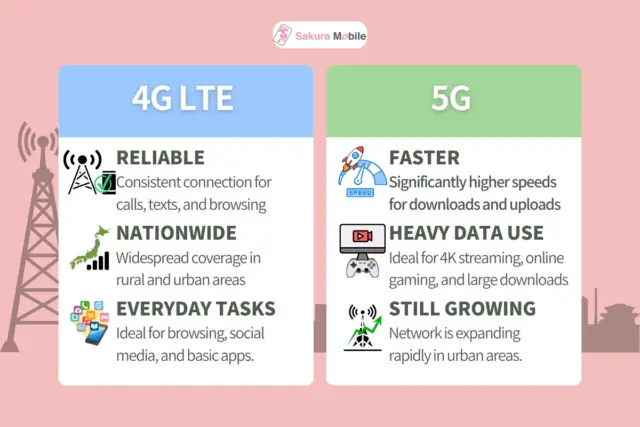
4G LTE has been Japan's main mobile standard for more than ten years. It's the layer that keeps you connected almost everywhere. It easily handles what most travelers actually do: checking maps, using translation apps, texting, browsing social media, and streaming most videos.
If your phone can't use 5G, or you're somewhere with weak 5G signal, 4G LTE is what keeps you online.
5G: The New Standard
5G is now widely available in Japan. It's the default connection on most current travel plans, including Sakura Mobile's. 5G offers faster downloads and smoother performance for heavy tasks—big downloads, video calls, uploading photos and videos, or using your phone as a hotspot for a laptop. Japan's 5G network has grown fast and keeps expanding. Like in any country, though, 5G speed and coverage can still vary by location and carrier.
Coverage can vary by carrier and region. For a full breakdown by itinerary, see our comparison guide.
Do You Need 5G, or Is 4G Enough for Your Trip?
For most travelers, 4G LTE is already fast enough. If your trip is mostly maps, translation apps, texting, social media, and normal photo sharing, you probably won't notice a difference between 4G and 5G.
5G is worth having if you:
- Stream videos often, in high quality
- Make video calls a lot
- Upload large photos or videos
- Use your phone as a hotspot for a laptop or tablet
- Work remotely and need a fast, steady connection all day.
Most current travel plans—including Sakura Mobile's—now come with 5G by default. So this isn't really a choice you need to make anymore. It's just useful to understand what you're getting, so you know if it actually matters for how you use your phone.
Frequency Bands: What Your Phone Needs to Support 4G and 5G in Japan

If your phone supports 4G LTE and 5G in general, it's still smart to check the exact bands. Not every "5G phone" supports every 5G band used in a given country.
Common 4G LTE bands across Japan include Band 1 (2100MHz), Band 3 (1800MHz), Band 18/19 (800MHz). Most modern phones support these bands:
au-Powered Unlimited Data Plan:
- 5G main bands: n77 (4.0GHz), n78 (3.7GHz)
- 5G support bands: n3 (1.7GHz), n28 (700MHz)
- 4G support bands: Band 1, Band 18
docomo-Powered 3GB/Day Data Plan (SIM/eSIM):
- 5G main bands: n78 (3.7GHz), n79 (4.5GHz)
- 5G support bands: n1 (2.1GHz), n28 (700MHz)
- 4G support bands: Band 1, Band 19
The 4G bands above aren't a separate 4G plan, Sakura Mobile doesn't sell one anymore. They're backup bands your phone can use where 5G signal is weak. Most phones from major brands support the bands listed above. If you're traveling with an older or regional phone, it's worth checking first.
Sakura Mobile's 5G travel eSIMs work with most unlocked, 5G-compatible phones. Our English-speaking support team can help you check before you order.
Is Your Phone Unlocked and Compatible?
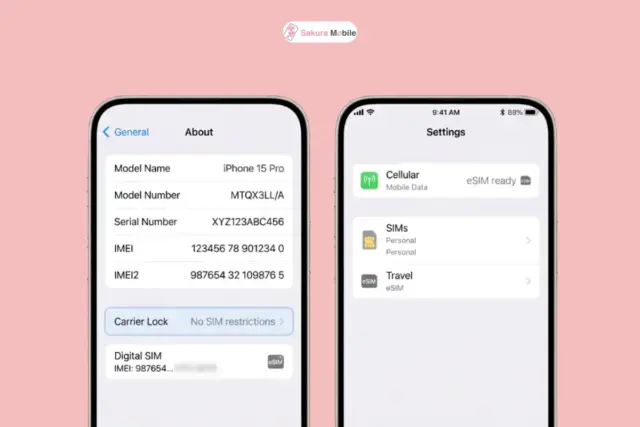
Before any of this matters, check two things: is your phone unlocked, and can it use a Japan travel SIM or eSIM?
Unlocked means your phone isn't tied to just one carrier. It will accept a SIM or eSIM from another provider. If you bought your phone outright, or paid it off in full, it's probably already unlocked. Not sure? Check your phone's settings under "About" or "Cellular" or ask your home carrier.
eSIM support depends on your exact phone model. Most phones from the last few years support eSIM, but some older or budget models don't.
| Phone | Usually Compatible? |
|---|---|
| iPhone XS or newer | Yes |
| Recent Google Pixel models | Usually |
| Recent Samsung Galaxy models | Usually |
| Older or carrier-locked phones | Check first—may need a physical SIM or Pocket WiFi instead |
Not sure if your phone is compatible?
Use Sakura Mobile's compatibility checker to check your device before you travel.
Getting Connected: SIM, eSIM, Pocket WiFi, or Roaming
Once you know your phone supports 4G and 5G, the last step is picking how to connect.
Physical SIM card: A small chip that replaces your home SIM. Your phone needs to be unlocked. You can order one online before your trip or buy one after you land.

💡 Good to Know: If you have an iPhone 14 or later purchased in the U.S., your device doesn't have a physical SIM tray. That means you should choose an eSIM, Pocket WiFi or international roaming instead.
eSIM: A digital SIM you install by scanning a QR code. No physical card is needed and you can set it up before you even board your flight. Your phone needs to be unlocked and support eSIM.
Pocket WiFi: A small device you carry and connect other devices to over WiFi. It doesn't touch your phone's SIM settings at all. That makes it the easiest choice if your phone isn't compatible, or you're sharing one connection with a group.
International roaming: Uses your home carrier's service in Japan. No setup needed, but it's usually the most expensive option per gigabyte. It works fine for very short trips, or as a backup plan.
| If you are... | Best option |
|---|---|
| A solo traveler with a newer phone | eSIM |
| Traveling with a group or several devices | Pocket WiFi |
| Using an older phone that can't use eSIM | Physical SIM |
| Want service the moment you land | eSIM |
| On a short trip and don't want to set anything up ahead of time | Roaming (expect a higher cost per GB) |
See our full guide to how to buy a Japan eSIM or check Pocket WiFi rental options.
Pre-Trip Connectivity Checklist
- Check that your phone is unlocked.
- Check that your phone supports 5G. Look up its frequency bands if you want to be thorough.
- Check eSIM compatibility, if that's the route you want. If not, plan for a physical SIM or Pocket WiFi.
- Pick how you'll reconnect—SIM, eSIM, Pocket WiFi, or roaming—based on your trip.
- Order or activate before you travel if you want service the moment you land.
Get step-by-step help setting up your phone from our English-speaking support team—before, during, and after your trip.
Sakura Mobile's 5G Travel Plans
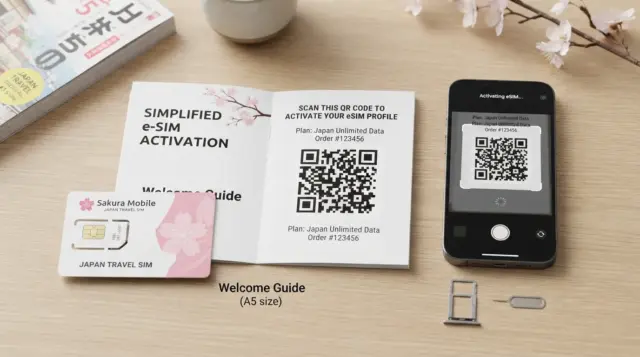
Once you know how you'll connect, picking a provider is simple. Sakura Mobile's travel eSIMs, and SIM cards use Japan's most trusted mobile networks, including au and docomo. Choose fully unlimited 5G data on the au-powered plan. Or choose reliable, high-speed data with up to 3 GB a day on a docomo-powered plan. Both come with English-speaking support.
If your phone isn't 5G-compatible, or you're traveling as a group, Pocket WiFi is also an option.
FAQ
- Q: What's the difference between 4G LTE and 5G in Japan?
A: 4G LTE is Japan's older, nationwide mobile standard. It's reliable for everyday tasks like maps and texting. 5G is faster and better for heavy data use, like streaming or hotspotting. Most current travel plans, including Sakura Mobile's now run on 5G by default.
- Q: Do I need 5G to visit Japan, or is 4G enough?
A: 4G LTE handles most travel needs just fine—maps, translation, texting, and typical streaming. 5G is worth it if you stream a lot, make frequent video calls, or use your phone as a hotspot. Most current travel eSIM and SIM plans come with 5G by default.
- Q: Does Sakura Mobile's eSIM support 4G LTE?
A: Sakura Mobile's current travel plans run on 5G, not a separate 4G plan. 4G LTE bands are supported as a backup for areas with weaker 5G signal, but there's no standalone 4G plan to buy.
- Q: What frequency bands does my phone need for Japan?
A: Common 4G LTE bands in Japan include Band 1, Band 3, Band 18, and Band 19. For 5G, Sakura Mobile's plans use bands including n77, n78, n79, n1, n3, and n28, depending on the plan and network.
- Q: Is Japan's 5G network reliable for travelers?
A: Japan's 5G network has grown a lot and works well in most areas travelers visit. Like anywhere, coverage can still vary by location, and carrier. 4G LTE stays as a strong, steady backup, so you're rarely left without service.
- Q: Do I need to unlock my phone before traveling to Japan?
A: Yes, if you plan to use a local SIM or eSIM. An unlocked phone can accept a SIM or eSIM from any provider, not just your home carrier. Most phones bought outright are already unlocked—check your settings or ask your carrier if you're not sure.
- Q: How does eSIM activation work?
A: You install a digital SIM by scanning a QR code or following steps in an app. There's no physical card.
Still have questions? Contact our support team for helping picking the right connectivity option for your trip.