
Are you ready to take off?
Welcome to our series on studying abroad in Japan!
Today, I'll cover everything you need for a smooth arrival:
- what to prepare before boarding the plane
- the forms you need to fill out during the flight
- what to do when you arrive at the airport in Japan
Let's get started!
- For preparation in your home country, check (Part 1) Before Leaving: What Should I Pack and Prepare?
- Planning your arrival at Haneda Airport? Check Your Complete Guide to Haneda Airport
Before Your Flight
Register for Visit Japan Web
Before boarding your flight, it is recommended to register for Visit Japan Web. Fortunately, as of April 2024, most of the complicated paperwork and quarantine procedures related to COVID-19 have been eliminated. However, immigration paperwork is still one of the main causes of delays at the airport.
For this reason, it's a good idea to complete your Visit Japan Web registration in advance. While it is not mandatory—you can still complete the process using paper forms—registering online can significantly speed up your immigration and customs procedures.
Visit Japan Web consists of three sections:
- Immigration information
- Customs declaration
- Tax exemption information
After completing all three sections, you will receive three QR codes. As an international student, you will only need the first two (immigration and customs) upon arrival. The third QR code is used for tax-free shopping and is mainly intended for tourists.

Tip: Screenshot/Print Your QR Code
In case you face internet problems or phone battery issues, we recommend taking a screenshot or printing out your QR code so you have a backup just in case anything happens.
Did you check your necessary luggage and register for Visit Japan Web? Now, let's get on board!


For Those Who Haven't Registered for Visit Japan Web:
You will need to fill out two forms on the airplane: the "Disembarkation Card for Foreigners (外国人入国記録)" and the "Customs Declaration Form" (full name: Declaration of Personal Effects and Unaccompanied Articles, 携帯品・別送品申告書).
Flight attendants will usually hand these out, but if they don't, be sure to ask for them. Preparing these forms on the plane will save you time and hassle after arrival. Especially when you have a lot of luggage, filling out forms at the airport can be tiring!
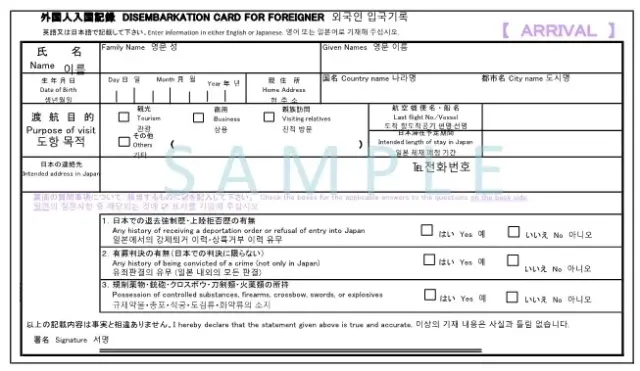
Disembarkation Card for Foreigners
★ For "Purpose of Visit"
- Long-term study (With Student Visa): Check "others" and write "Study" or "留学"
- Short-term study (Without Student Visa, Less than 90 days): Check "others" and write "Short-term study" or "短期留学"
★ For "Intended address in Japan"
- Write your Japan home address either in English or Japanese (Kanji)
- If you don't have a home address or phone number yet, you can write your school's address and phone number
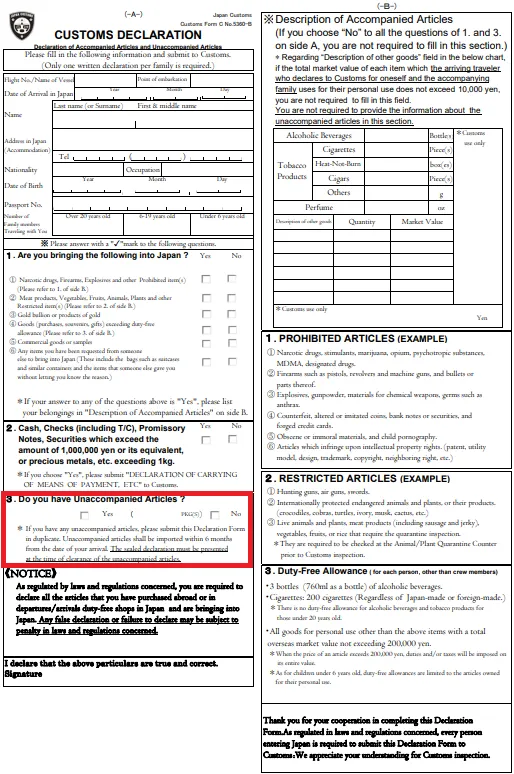
Customs Declaration (Declaration of Personal Effects and Unaccompanied Articles)
★ For 3. Do you have Unaccompanied Articles? (Red box in the above image)
- Check "Yes" and write the number of parcels only if you have sent a package via EMS or an international shipment from your home country.
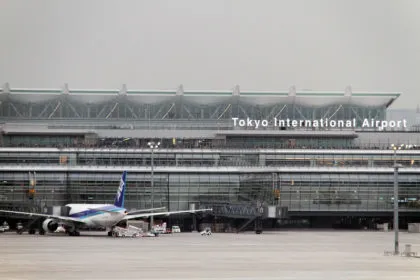
Quick flow at the airport:
Immigration Inspection
(Submit your Disembarkation Card for Foreigners, passport, COE, student visa, and work permit application form to receive your Residence Card with a work permit stamp)
↓
Baggage Claim
↓
Customs Inspection
(Submit your Customs Declaration Form)
↓
Arrival Lobby
(Pick up your SIM card or Pocket WiFi if needed)
At the Immigration Inspection
Receive Your Residence Card
What is a Residence Card?
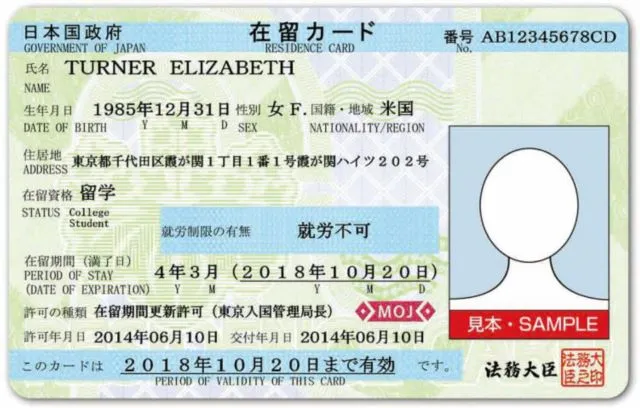
A Residence Card is issued to residents staying in Japan for over three months with a mid- to long-term visa. It shows your identification information, period of stay, your status of residence, etc. You need to carry your residence card at all times, as it can be used as ID for official procedures. If you are a long-term student, you'll have to renew your Residence Card at the "Immigration Services Agency of Japan (出入国在留管理庁)" later on in your stay. You can apply for the renewal three months before the date of expiration.
When/Where to Receive Your Residence Card
- Narita, Haneda, Kansai, Chubu, New Chitose, Hiroshima, Fukuoka AirportYou will receive your Residence Card at the immigration inspection. Once you present your passport, COE, student visa (all are likely attached to your passport), and possibly the admission letter from your enrolled school, the officials will print out the card right there.
- Other AirportsYou will NOT receive your Residence Card at the Immigration inspection. You will receive a seal confirming the landing verification, along with a note, "Residence card will be issued at a later date." Your Residence Card will be issued after you follow the residency procedure at the municipal office of your city/ward/town. You should complete the residency procedure within two weeks after arrival. (We recommend completing this as soon as you arrive in your new city/town/ward!)
Apply for Work Permit
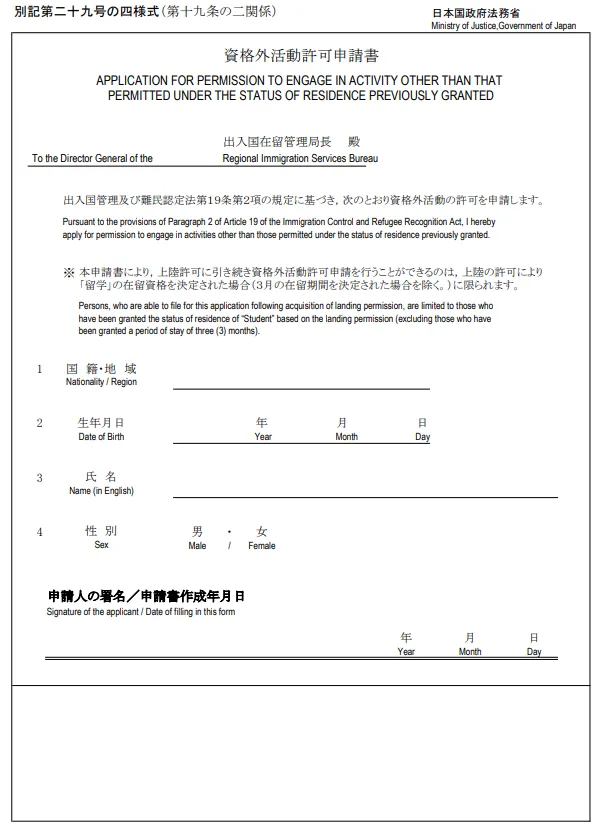
Work Permit Form (for newly entering international students)
This is the part I neglected and caused me an extra two weeks to obtain permission for a part-time job. In principle, a student visa does not allow one to work in Japan as a foreigner. If you wish to get a part-time job or an internship, you must apply for a "work permit."
With the work permit, you can work up to 28 hours per week during the school semester and 40 hours per week, 8 hours per day during the summer/winter/spring breaks. Jobs related to the sex industry, such as hostess bars/clubs, love hotels, adult goods or video stores, massage parlors, or video game arcades, are restricted.
Even if you don't imagine yourself working part-time in Japan, I highly recommend completing this process. You never know! You also need to renew the work permit as you renew your period of stay. If you forget to, you'll be working illegally without realizing it.
How to Apply for Work Permit
It's simple. When submitting the document to create the residence card at the immigration inspection, submit the filled-out "Permit to Engage in Activity Other than that Permitted by the Status of Residence Previously Granted" application together.
You can download it from here.
Go under [申請書・必要書類・部数] and download either 資格外活動許可申請書, which is a basic form, or 資格外活動許可申請書(留学生が新規入国する場合)which is for newly entering international students. Your school might send you the form or have information about the work permit on their websites.
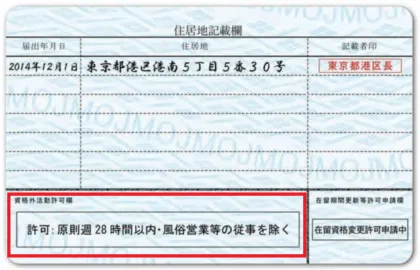
If you forgot to write it beforehand, ask the inspector for one. When you receive your residence card, there will be a stamp on the back, like the following image.
At the Arrival
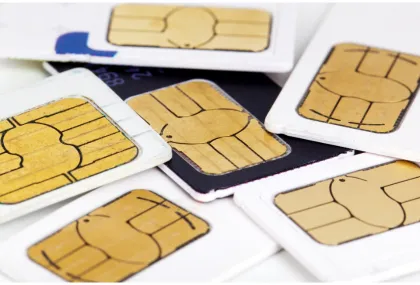
If you reserved a mobile SIM card in advance and decided to pick it up at the airport, head to the carrier counters at the arrival lobby. Make sure to check the locations and operating hours.
Sakura Mobile provides pick-up services at six airports: Narita, Haneda, Kansai, Chubu, New Chitose, and Naha airports. Check here for Sakura Mobile's airport counter locations!
In case you need immediate internet access for multiple devices after arrival, Sakura Mobile also provides short-term and long-term Pocket WiFi. Make a reservation online at least 3 days before your pickup date and pick up right away at the airport. After arriving in Japan, you'll need to search the internet for information about official procedures, etc. A stable internet connection through Pocket WiFi, in addition to a SIM card, can eliminate the fear of running out of internet access.

Conclusion
When I first arrived in Japan, I remember feeling overwhelmed by the Japanese language, heavy luggage, and the constant anxiety of losing important documents (especially with the complex quarantine procedures back in 2022...).
After reading this article, I hope you have a safe and smooth journey to Japan. Congratulations on taking your first step!
Before you head off to enjoy life in Japan, are you aware of the important procedures you need to complete as soon as you arrive? From registering your address to applying for national health insurance, these steps can be confusing if you're unfamiliar with Japanese terminology.
Moreover, these procedures must be completed in a specific order. If not, you might end up:
- Visiting the ward office multiple times and waiting in long lines
- Receiving a notice filled with difficult Japanese by mail—and panicking about what you have missed while asking everyone you know for help
To stay on track and simplify the process, bookmark our blog and check out the next article in the series:
(Part 3) After Arrival: 4 Important Procedures
We'll also be sharing more tips on setting up your life in Japan soon, so stay tuned to our Study Abroad Series for everything you need to know about studying in Japan!