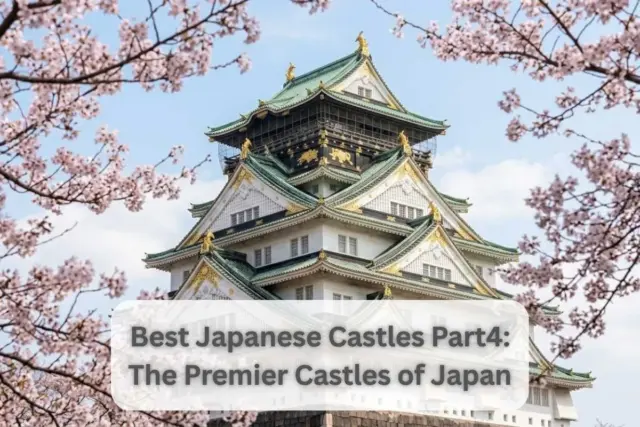
Welcome back to our Best Japanese Castles series! As we introduced Himeji Castle and Nijo Castle in our last articles, today we’ll introduce three more castles known as the “premier castles” of Japan –Kumamoto Castle, Osaka Castle, and Nagoya Castle.
These three castles were ranked as 三名城 (sanmeijou).
This means that these top 3 castles were chosen for their functionality, beauty, and historical aspect from Kenroku Gaisho by the Edo-period scholar Ogyu Sorai. But, if you search “sanmeijou,” you’ll discover that this topic goes beyond!
Although there is no “official” list of premier castles, let’s look closely at thse three castles that are historically chosen for their architecture and designs!
Deciding which castle to visit can be difficult when there are too many castles. You might want to choose based on architectural defense, historical experience, or seasonal aesthetic beauty.
One of the best ways to choose your travel destinations is through scenic architecture.
Ogyu Sorai selected three castles from the Edo-Period (1603-1868) based on their strategic design and beauty, which remain popular tourist destinations today!
Check out the list and details and see if you agree!
Who was Ogyu Sorai?
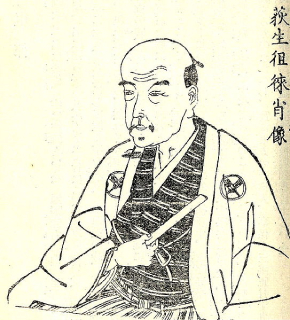
Ogyu Sorai (1666-1728) was an influential Confucian scholar and philosopher from the Edo period. He recorded his rankings of the top three castles of Japan in “Kenroku Gaisho,” his book on military strategy. His list was based on castle designers he admired, such as Kato Kiyomasa and Todo Takatora.
Let’s go over what Ogyu Soari considered as premier castles!
Kumamoto Castle (熊本城)
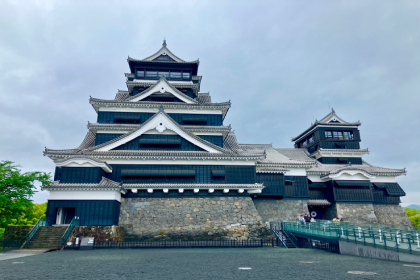
First, let’s look into Kumamoto Castle. As we covered the types of castles in part 1, you may be familiar with 平山城 hirayamajiro, a castle built on a hill overlooking a plain. Kumamoto Castle is this type!
What makes Kumamoto Castle Unique?
Being one of the old castles that keeps the original structure, did you know that it also has a feature called “Musha-gaeshi,” meaning warrior repellent walls. These walls were tactically made for the enemies and ninjas to find it very hard to climb or attack.
After the 2016 Earthquake, some stones on the wall collapsed, but there were many of the stones that survived, which presents how Kiyomasa might have considered earthquake resistance while designing.
History
The first foundation of the castle was laid in 1467, by the Ideta clan. The first feudal lord of Kumamoto, Kato Kiyomasa, began the castle’s expansion in 1607, and finished construction in the same year.
During the Satsuma Rebellion of 1877, the struggles between samurai and the Meiji government caused the castle to be besieged and was burned down but has gone through various restorations since 1960.
However, the 2016 Kumamoto Earthquake caused severe damage to the castle and is still in progress of rebuilding it to its original state.
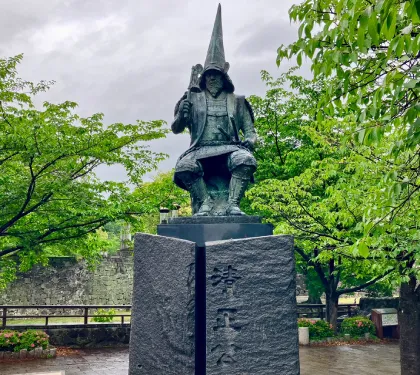
Statue of Kiyomasa Kato
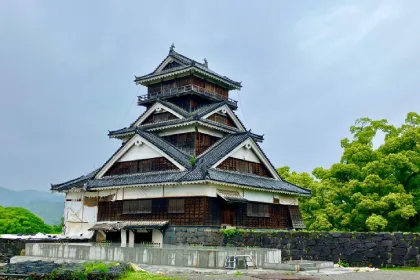
Uto Turret at Kumamoto Castle
Inside the Castle Grounds
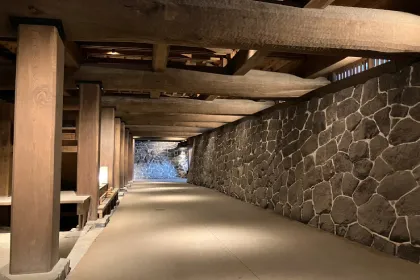
The main castle is modernized by having AC, which makes exploring the exhibits comfortable even during the peak of Japan’s humid summer. There are also elevators, making it very accessible for wheelchairs, strollers, and for all visitors!
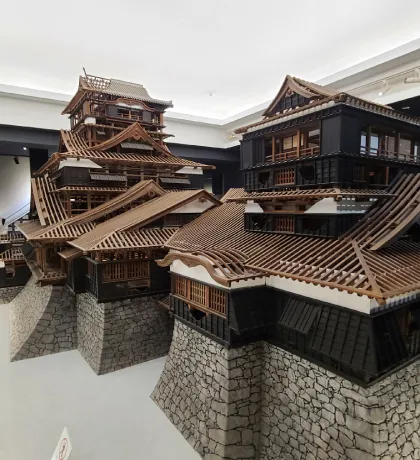
From the 6th floor of the main castle, Tenshukaku, you can see the view of Kumamoto City. The interior of the castle serves as a museum, displaying the history and artifacts of Kumamoto prefecture.
Inside the Honmaru-goten Palace sits the Shokun-no-Ma Great Hall. Although currently closed for restoration, this room is famous for its bright gold walls. Across the room, beautiful artwork depicts seasonal plants and the story of Wang Zhaojun, a tragic heroine connected to Emperor Yuan of the Han Dynasty.

Basic Information
Location – Honmaru, Chuo Ward, Kumamoto City, Kumamoto Prefecture
Opening Hours – 9:00-17:00 (Last admission 16:00)
Admission Fee – Main entrance fee: 800 yen (High school students and older);
Combo for Two-Facility pass (Kumamoto Castle・Wakuwaku-za): 850 yen to access;
Combo for Three-Facility pass (Kumamoto Castle・Wakuwaku-za・Museum): 1,100 yen
Access – Take the tram from JR Kumamoto Station (17 min. ride) and get off at Kumamotojo-mae
Translation – The Kumamoto Castle App provides audio guides and translations in English, Korean, and Chinese.
Official Site - https://castle.kumamoto-guide.jp/en/
*The castle is still undergoing renovations from the severe damage from the 2016 earthquakes, but the main castle is restored and can be seen from the top of the tower.
Have You Booked Your eSIM/SIM Card or Pocket WiFi for Your Trip to Japan?
Stay connected with high-speed data throughout Japan! By reserving online before departing, you can avoid stock shortages. Check out our products below to find the best option for your trip.


Osaka Castle (大阪城)
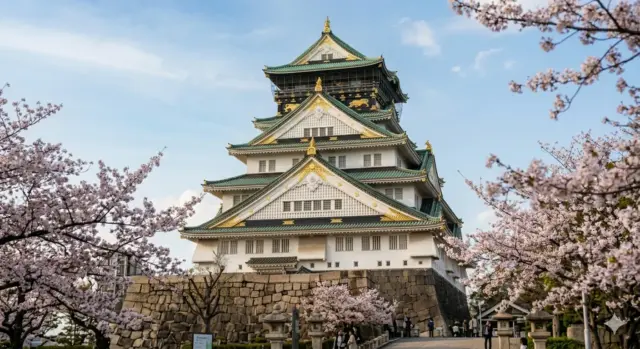
Next, let’s look at Osaka Castle, a flat mountain castle (平山城/hirayamajiro) that is one of the famous scenic sites for tourists in Osaka!
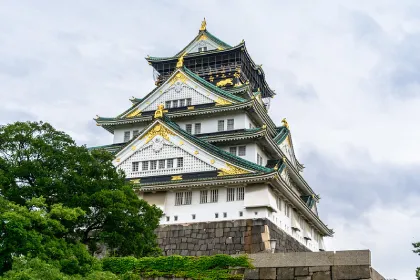
What makes Osaka Castle unique?
Unlike other historically preserved castles, Osaka Castel has modern interior with concrete durability. However, the exterior retains the iconic traditional Japanese architecture.
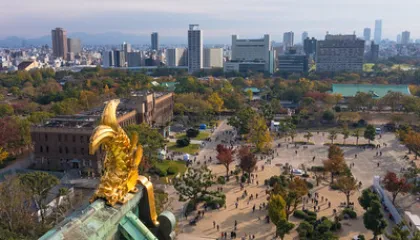
Therefore, it is also known for its beautiful decorations, including the 鯱 (shachihoko), a carp with dragon/tiger heads, on the roof, with the beautiful contrast of white and green walls and facade. These mythical creatures were placed on castle roofs, the highest points, in hopes to serve as protecting the flammable wooden structure against fires and for the symbol of wealth.
It is said that Hideyoshi loved gold, and by using gold to build it, Osaka Castle is also known as 錦城 or 金城 (Kinjo), which translates to “golden castle.”
Try taking a picture of Osaka Castle’s gold leaf embellishments shining at sunset!
History
Osaka Castle began construction in 1583 under the feudal lord Toyotomi Hideyoshi, a famous historical figure known for unifying Japan after the Warring States Period (1467-1567).
Like other Japanese castles, Osaka Castle has been destroyed and rebuilt multiple times throughout its history. The original castle was destroyed in a battle called “Osaka Natsu no Jin,” or the Siege of Osaka Castle (1615). You can see an exhibit, depicting this battle of the Tokugawa army attacking, on the 5th floor of the main castle.
The Tokugawa shogunate began rebuilding Osaka Castle in 1620 on top of the old ruins. The main tower that we know today was reconstructed with concrete in 1931 and the most recent renovation was completed in 1997.
Inside the Castle Grounds
Roughly one million large stones are estimated to have been used in Osaka Castle’s massive stone walls. While you are there, try looking for the tako-ishi (octopus stone), which is said to be the largest castle stone in Japan!
Another impressive defense measure is the castle’s moat, which has walls up to 20 meters tall and 90 meters wide.
Inside the Tenshukaku, the main castle keeps, you’ll find a museum with artifacts and information about the Toyotomi clan.
Go to the 8th-floor observation deck (which is fully accessible) for a stunning, 360-degree panorama of the city and its surroundings."
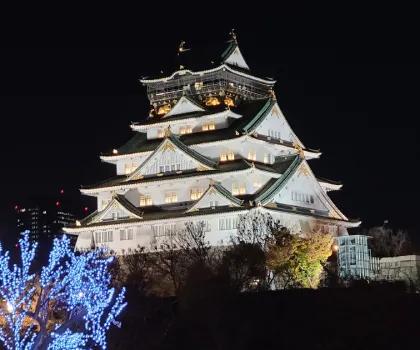
If you visit in the spring, make sure to stroll through Nishinomaru Garden, known for its 600 cherry trees. It’s a popular spot for hanami (cherry blossom viewing), and you can take great photos with sakura and Osaka Castle together! In winter, you can look forward to the “Osaka Castle Illuminage,” where you can enjoy illuminations spread throughout the garden.
Basic Information
Location – Chuo Ward, Osaka City, Osaka Prefecture
Opening Hours – 9:00-18:00 (Last admission 17:30)
Admission Fee – Main entrance fee: 1,200 yen; 600 yen for high school and university students; Free for children 15 years of age
Access – Take the JR Osaka Loop Line. Easiest access from Morinomiya or Osakajokoen Station.
Translation – Translated Leaflets available in English, Korean, and Chinese; Audio guide devices are available for free rental
Official Site - http://osakacastlepark.jp/
Nagoya Castle (名古屋城)
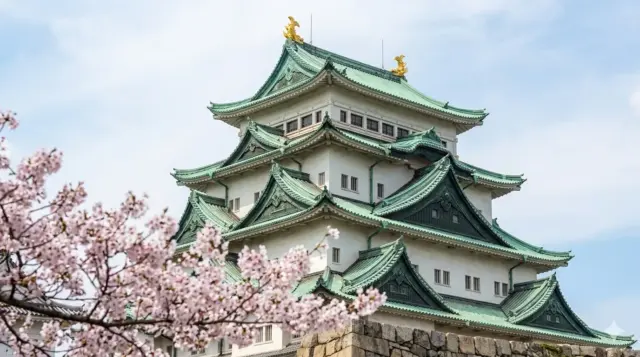
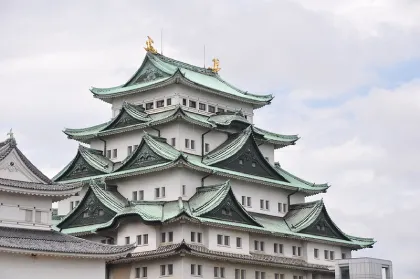
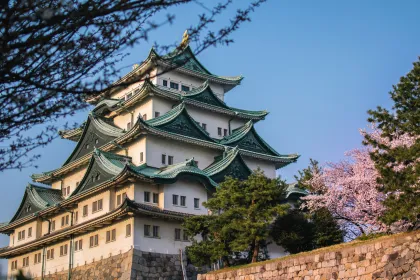
Finally, let’s explore a 平城 hirajiro, a flat plain castle, Nagoya Castle!
What makes Nagoya Castle unique?
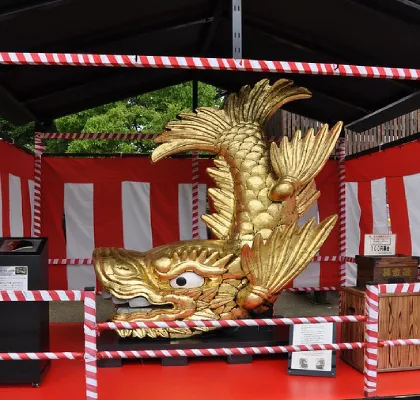
Nagoya Castle, like Osaka Castle, also has two sachihokos on the roof. However, Nagoya’s sachihokos is also known as “kinshachi,” since they are plated in 18-karat gold! Each kinshachi, is over two meters tall and weighs over 1,200 kilograms.
They have become a famous symbol of Nagoya castle and Nagoya itself.
Many castles in Japan have been rebuilt using more modern methods, but plans are underway to tear down the concrete replica of Nagoya Castle and rebuild the main castle using traditional methods and wooden materials.
History
Nagoya Castle started its construction in 1610 under Tokugawa Ieyasu, the same person who had won over the Osaka Castle that solidified Tokugawa’s rule over Japan!
Tokugawa originally built the castle because he was still wary of his enemies near Osaka. He placed his son, Yoshinao, for a residence of the castle and put him in charge of the region.
Contrary to the shogun’s fears, the castle was never attacked, and arts such as tea ceremony and ceramics flourished in the region. Thanks to its strategic location, Nagoya became one of the most prosperous cities in the Edo Period.
The castle was unfortunately destroyed by firebombing in World War II. However, decades later in 1959, it was reconstructed using concrete.
Inside the Castle Grounds
The highlight of Nagoya Castle is its reconstructed Honmaru Palace. It is made entirely from wood and faithfully restored using traditional methods. Visitors can admire the golden murals, traditional Japanese paintings, and ornate carvings. If you appreciate traditional Japanese art, or simply want to see some pure gold, you should definitely come see it!
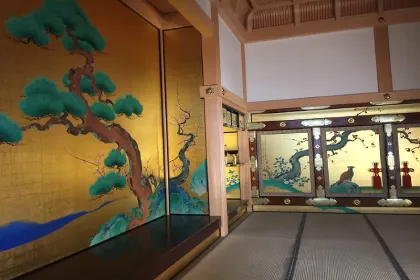
Photo courtesy of Akihito Fujii, Flickr
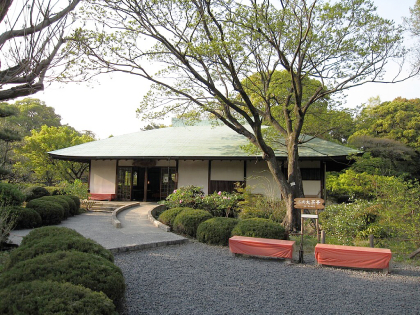
Ninomaru Garden, that surrounds the castle, was the largest garden connected to any lord’s residence at that time. It is a beautiful Japanese-style garden that still delights visitors today. As you walk through the gardens, you’ll also encounter several tea houses in the rear “Ofuke-maru” area. Stop by Ninomaru Tea House for green tea and Japanese sweets in a calming, nature-surrounded area!
Remarkably, all three corner watch towers survived the fires, and you can see the original Southwest Corner Tower with its ishi-otoshi, or slots to drop stones. You can also search for the biggest stone used for the defensive walls, named after one of the castle architects who brought it ー the famed Kiyomasa Kato.
Basic Information
Location – Honmaru, Naka Ward, Nagoya City, Aichi Prefecture
Opening Hours – 9:00-16:30 (Admission until 16:00)
Closed: December 29 – January 1
Admission Fee – Adult: 500 yen; Free for junior high and below.
Access – Walk 25 min. from Nagoya Station or take the subway to Shiyakusho Station.
Translation – Japanese, English, Chinese, and Korean available on website;
Free English-speaking tours by Aichi Goodwill Guides Network (AGGN).
Official Site - https://www.nagoyajo.city.nagoya.jp/en/
*Cannot enter the main tower of the castle, since it is currently restricted.
Stay Connected to Enjoy visiting different castles to the Fullest!
Don’t forget to book your Japan eSIM to stay connected and smoothly navigate while visiting the different castle. Check out our products below and find the best option for your trip.Conclusion
What did you think of these three premier castles? Do you agree with the list? After learning about several different castles, try visiting a few castles and making your own list!
Why not explore a little deeper into history? Japanese castles are not only historical and cultural sites, but they also offer stunning seasonal scenic views of the city, making them the perfect spot to snap some unforgettable photos!
Take time out of your trip to visit some of the wonderful Japanese castles!

Related Articles
If you haven’t read our “Best Japanese Castles” series, check them out!
Part 1: Japanese Castle Basics
Part 2: Himeji Castle
Part 3: Nijo Castle
Check out our homepage for more details! 👀