- TL;DR
- Not Sure You're At the Right Airport?
- Before You Land: Visit Japan Web
- Kansai Airport WiFi
- Recharging Spots & PC Desks
- Portable WiFi, SIM Cards & eSIM
- Which Network Does Sakura Mobile Use?
- Information Counters & Luggage Services
- Transportation: Getting Around & Into the City
- Terminal 1 Guide
- Terminal 2 Guide
- Where to Shop & Eat
- Nearby Tourist Attractions
- Get Your Sakura Mobile SIM, eSIM, or Pocket WiFi at KIX
- What Makes Sakura Mobile Different?
- FAQ
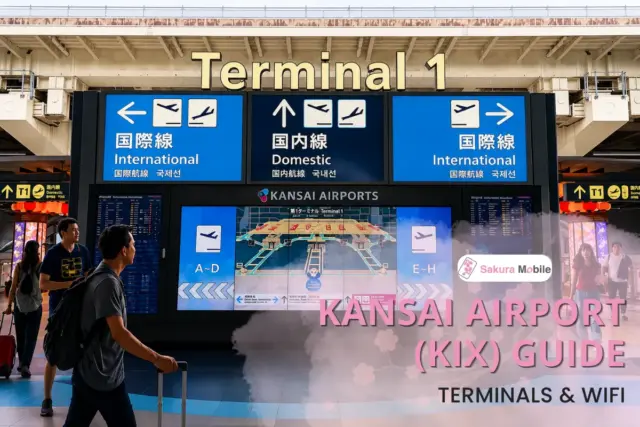
Kansai International Airport (KIX) is the main gateway to Osaka, Kyoto, Nara, and Kobe. This guide coveres everything you need for a smooth arrival: how the terminals are laid out, how to get into the city, how to get online right away, and which mobile network to trust for the rest of your trip.
If you're flying into a different city, check out our guides to Haneda Airport, Narita Airport, and Fukuoka Airport instead.
TL;DR
Kansai International Airport (KIX) has two terminals: Terminal 1 for most full-service airlines and Terminal 2 for many low-cost carriers. Free WiFi is available, but a SIM card, eSIM, or Pocket WiFi is a more reliable way to stay connected across Japan. Complete Visit Japan Web before you arrive to speed up immigration and customs. You can reach Osaka, Kyoto, Kobe, and Nara by train, bus, or taxi from the airport.
Not Sure You're At the Right Airport?
The Osaka area actually has three airports, and it's a common mix-up—especially since one of them shares "International" in its official name without actually being international.
| Airport | Code | Handles | Distance from Osaka |
|---|---|---|---|
| Kansai International Airport | KIX | International flights, plus some domestic flights | ~60 minutes to central Osaka |
| Osaka Itami Airport (Osaka International Airport) | ITM | Domestic flights only No duty free | ~60 minutes to central Osaka |
| Kobe Airport | UKB | Mostly domestic, growing international | ~90 minutes to central Osaka |
If you're flying in from another country, you'll almost certainly arrive at Kansai International Airport (KIX). Osaka Itami Airport (ITM) only handles domestic flights within Japan. To help distinguish it from KIX, which serves international flights, the airport officially adopted the name Osaka Itami Airport in January 2025.
Before You Land: Visit Japan Web
Visit Japan Web is a free, official online system from the Japanese government that lets you submit your immigration and customs information before you fly, in exchange for a QR code that speeds up your arrival.
Here's how it works:
- Go to https://www.vjw.digital.go.jp and create an account.
- Register your passport details, flight information, and where you're staying in Japan.
- Complete both the immigration and customs sections—since 2024, these are combined into a single QR code.
- Finish at least a few hours before you land, then screenshot or save your QR code.
- At KIX, scan your QR code and passport at the arrival area's automated kiosk instead of waiting in the paper-form line.
Is it required? No—paper arrival cards and customs declarations are still handed out on the plane and accepted at KIX. However, registering ahead of time is free, takes about 10-15 minutes, and can save you a wait at a busy arrival time.
Kansai Airport WiFi
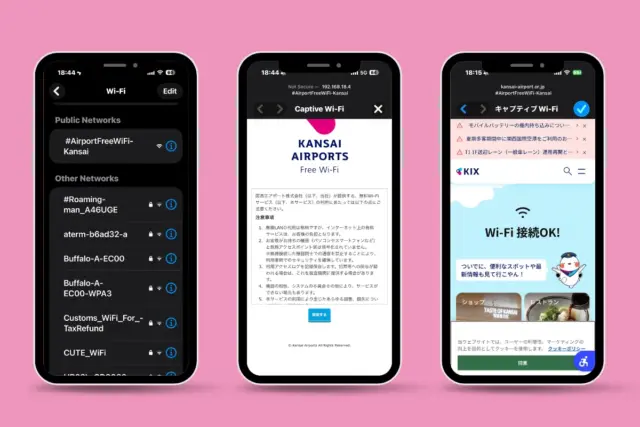
Is KIX WiFi free? Yes. Both Terminal 1 and Terminal 2 offer free WiFi through a network called AirportFreeWiFi-Kansai. It works well enough to message family, check maps, or post a landing photo.
Here's how to connect:
- Open your device's WiFi settings and turn WiFi on.
- Choose the network named "AirportFreeWiFi-Kansai" (it may show a slightly different name that starts with "AirportFreeWiFi-Kansai").
- A connection screen will pop up. Read and accept the Terms and Conditions.
- Once you accept, you're online. No extra steps, no sign-up form.
If your laptop doesn't have a wireless card, you can still get online. Computer desks near the Power Source Service Spots have LAN cables you can plug into directly.
One thing to know: free airport WiFi is great for a quick check-in, but it's not built for a full day of navigation, translation apps, or ride-hailing once you leave the terminal. Most travelers pair it with a rented SIM card, eSIM, or Pocket WiFi.
Recharging Spots & PC Desks
Need to charge your phone after you land? Kansai Airport provides free charging areas in both Terminal 1 and Terminal 2. Most are located in departure areas, with additional charging spots available in the arrival areas.
| Terminal | Floor / Area | Number of Charging Areas |
| Terminal 1 | 4F—International Departures | 3 |
| Terminal 1 | 2F—Domestic Departures & Arrivals | 19 |
| Terminal 1 | 1F—Arrivals Lobby | 2 |
| Terminal 2 | 1F—Departures & Arrivals | 5 |
Note: Terminal 1 completed its five-year renovation in June 2026. Charging areas remain available throughout the terminal, but signs and exact locations may differ slightly from older airport maps.
Portable WiFi, SIM Cards & eSIM
If you want reliable data for your entire trip—not just inside the terminal—you'll want to rent or activate one of three things before or right after you land:
- Pocket WiFi: a small device that creates its own WiFi hotspot. Good for groups or multiple devices sharing one connection.
- Physical SIM card: swaps into your phone's SIM slot. Good if your phone doesn't support eSIM.
- eSIM: activates digitally, no physical card needed. Good for solo travelers who want the fastest setup, and can even be activated before you land.
- Voice + Data SIM: includes a real Japanese phone number for calls and SMS, on top of data—worth it if you need to book restaurants by phone or receive SMS verification codes.
All are available to order online in advance and pick up at the Sakura Mobile counter in Terminal 1, or activate immediately if you choose eSIM. For a full breakdown of options, see our guides to the best Pocket WiFi rentals at Kansai Airport, best SIM cards at Kansai Airport, and best eSIM for Osaka, Kyoto, Nara & Kobe.
Not sure which one fits your trip?
| If you're... | Best option |
| Looking for the fastest setup | eSIM |
| Traveling with multiple devices | Pocket WiFi (one hotspot, share the connection) |
| Using a phone that doesn't support eSIM | Physical SIM card |
| Needing a Japanese phone number for calls | Voice + Data SIM/eSIM |
Which Network Does Sakura Mobile Use?
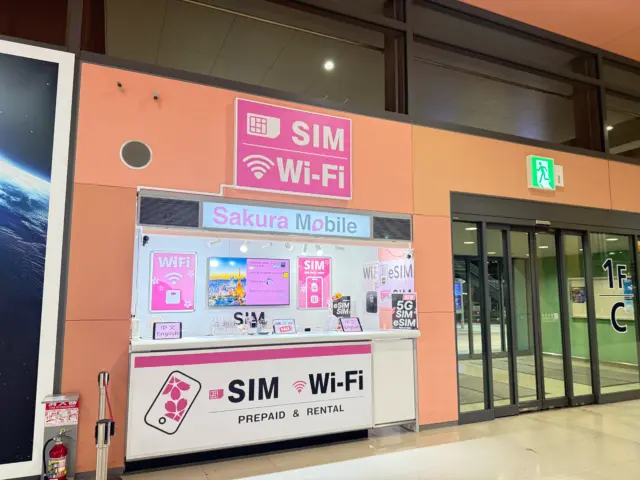
Sakura Mobile's Pocket WiFi runs solely on docomo, while SIM cards and eSIMs run on docomo and au—all reliable, nationwide 5G-capable networks.
Planning day trips beyond Osaka or Kyoto? Coverage can vary by destination—see our full docomo vs. SoftBank vs. au network comparison for a full breakdown by carrier and destination.
Pick up your Sakura Mobile SIM or Pocket WiFi at KIX:
 Location:Terminal 1, 1F Arrival Lobby
 Hours:6:00 AM - 11:00 PM, every day
Order online before your trip, compare plans in advance, and skip the line—just walk up to the counter after landing.
Information Counters & Luggage Services
Look for the counters marked with the large "i" symbol. Staff generally speak English and can help with:
- Transport to and from Japan's major airports
- Trains, subways, taxis, and buses
- Flight arrival and departure info
- Hotels near the airport
- General terminal directions
What they can't do: information counters aren't SIM/Pocket WiFi rental desks and can't set up mobile data for you—for that, head to the Sakura Mobile counter.
Other practical services worth knowing about:
- Currency exchange: Counters are available on multiple floors of both terminals, in arrivals and departures areas.
- ATMs: Located throughout both terminals, including several that accept foreign cards.
- Prayer rooms: Gender-separated prayer and ablution rooms are available on 3F of Terminal 1, with additional rooms located past security in the international departure area. Prayer mats are provided and the rooms are open to any faith.
- Coin lockers: Available in various sizes throughout both terminals.
- Luggage storage & forwarding: Staff counters (JAL ABC and Kansai Airport Baggage Service) are located at the north and south end of Terminal 1's 1F. Same-day delivery services can send your bags straight to your hotel, so you can start exploring hands-free.
- Rest lounges: Paid lounges—including Cafe Lounge NODOKA—offer seating, 24-hour showers, and a quiet place to recharge between flights.

Transportation: Getting Around & Into the City
Getting Between Terminals
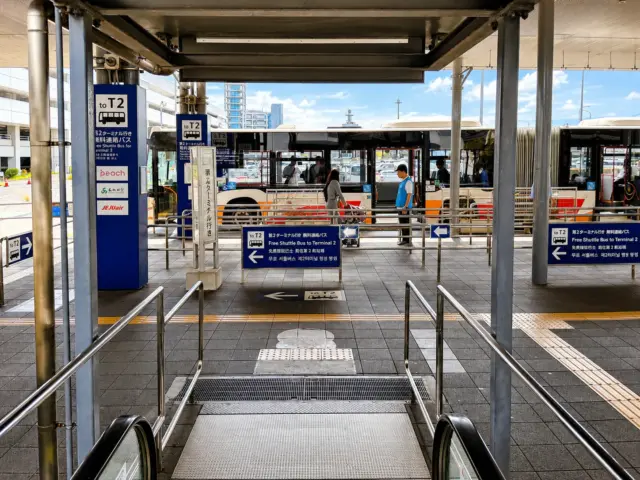
The easiest way to move between Terminal 1 and Terminal 2 is the free shuttle bus connecting Aeroplaza (next to Terminal 1) and the Terminal 2 building. The ride takes about 7 to 9 minutes.
Good to know: shuttle buses can be delayed by traffic, and there's no compensation if a delay causes you to miss a flight or train connection. Build in extra time, especially if you're transferring between terminals close to your departure.
Getting From Kansai Airport to Osaka, Kyoto, Kobe & Nara
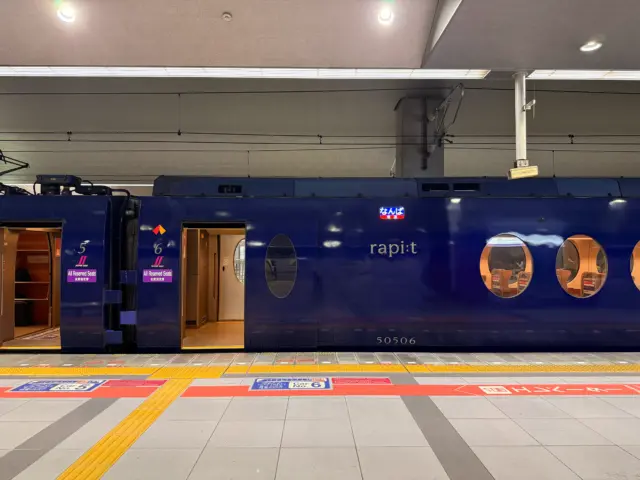
Your best option depends on your destination, your budget, and how much luggage you're carrying. Here's a full comparison in Japanese yen:
| Line / Service | Destination | Time | Price (one-way, adult) | Best for |
| Nankai Airport Express | Namba (Osaka) | ~45-50 min | 970 JPY | Budget travelers, light packing |
| Nankai Rapi:t | Namba (Osaka) | ~35-40 min | 1,670 JPY | Fast, reserved-seat comfort into Namba |
| Airport Limousine Bus | Namba (Osaka) | ~50 min | 1,400 JPY | No transfers, good for heavy luggage. |
| Kansai Airport Rapid | Tennoji | ~55-60 min | 1,060 JPY | Cheaper option toward central Osaka |
| JR HARUKA | Tennoji | ~30-35 min | 2,150 JPY | Quick hop toward central Osaka |
| Kansai Airport Rapid | Osaka Station | ~70 min | 1,180 JPY | Cheapest direct train to Osaka |
| JR HARUKA | Osaka Station | ~45-50 min | 3,310 JPY | Direct to Umeda/Osaka Station area |
| Airport Limousine Bus | Osaka Station | ~60 min | 1,800 JPY | Direct to Umeda, no train transfers |
| JR HARUKA | Kyoto Station | ~80 min | 3,990 JPY | Fastest direct train to Kyoto |
| Airport Limousine Bus | Kyoto Station | ~110-115 min | 2,800 JPY | Best for heavy luggage headed to Kyoto |
| Taxi | Central Osaka | ~50-70 min | ~16,000-25,000 JPY | Late-night arrivals, groups, heavy luggage |
| Kobe Bay Shuttle (ferry) | Kobe (Sannomiya) | ~40-50 min | 1,880 JPY | Fastest, most scenic route to Kobe |
| Nankai + Osaka Loop Line | Nara | ~95-100 min | 2,250 JPY | Budget route, one transfer required. |
Prices are approximate and can change. Always confirm current fares at station ticket machines or official carrier websites before you travel.

Tip for late-night or early-morning flights: the last Haruka train typically departs around 10:00-10:20 PM. If you land later than that, a Limousine Bus or taxi may be your only option into the city that night—or you can stay near the airport itself; see Aeroplaza below for 24-hour food and hotel options.
Getting to Universal Studios Japan
There's no single direct train, but two solid options to get you there:
- Airport Limousine Bus: a direct bus runs from Terminal 1's arrival hall to Universal Studios Japan, not transfers. It takes about 70 minutes and costs roughly 1,600-1,800 JPY.
- Train: take Kansai Airport Rapid Service to Nishikujo Station, then transfer to the JR Yumesaki (Sakurajima) Line for one stop to Universal City Station. This takes about 70-80 minutes with one transfer and costs 1,180 JPY.
If you're carrying luggage and want to avoid a transfer, the bus is the easier choice. If you have an IC card or a JR pass that covers the route, the train works out cheaper.
Planning a visit to Universal Studios Japan? Check out our complete USJ guide for transport tips, recommended rides, restaurants, hotels, and other helpful advice before you visit.
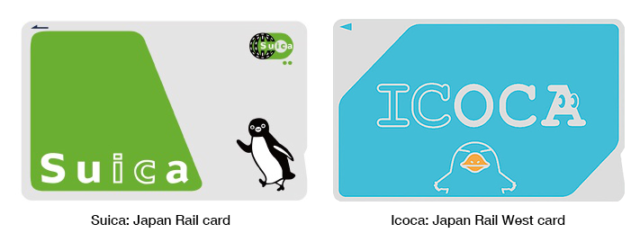
For most visitors, an ICOCA or Suica card is the easiest way to get around Japan. You simply add money to the card and tap out on trains, subways, and buses.
| Pass | Covers | Best for |
| ICOCA / Suica | Pay as you go on most train, subways, and buses across Japan | Most travelers |
| JR West Kansai Area Pass | Unlimited JR trains, including the Haruka Express from Kansai Airport (KIX) | Travelers taking JR trains between Osaka, Kyoto, Kobe, Nara, or Himeji |
| Kansai Thru Pass | Unlimited rides on private railways, subways, and buses (not JR) | Travelers using private railways such as Hankyu, Keihan, or Kintetsu |
| Osaka Amazing Pass | Osaka Metro, city buses, and free entry to some attractions | Travelers spending most of their time in Osaka |
An ICOCA or Suica card is enough for most trips. Both cards work across Japan and can also be used at many convenience stores, vending machines, restaurants, and shops.
If you're taking the Haruka Express from Kansai Airport and planning several JR day trips, the JR West Kansai Area Pass may save you money. If you'll mostly travel on private railways between Osaka, Kyoto, Kobe, and Nara, the Kansai Thru Pass may be the better option.
Terminal 1 Guide
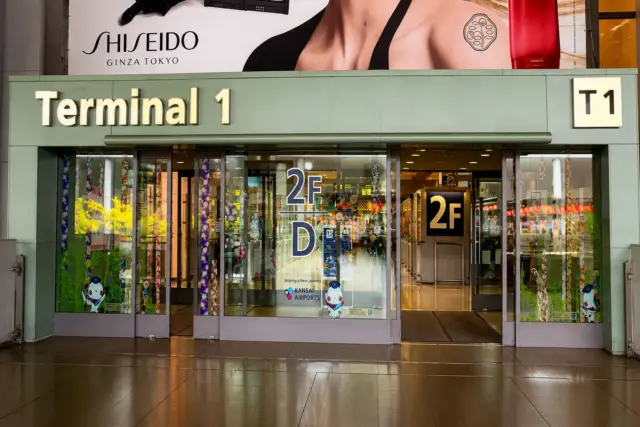
Terminal 1 is organized by floor, so once you know the layout, getting around is simple:
| Floor | What's there |
| 1F | Arrivals Lobby, Bus & Taxi Pick-up, WiFi rentals, currency exchange, tourist information, luggage storage/sending |
| 2F | Domestic departures and arrivals, shops, dining |
| 3F | International arrivals, paid rest lounges, prayer rooms, Duty Free shops |
| 4F | International departures, security, gacha area |
Terminal 1's five-year renovation was complete done June 2, 2026.The final phase added 24 new shops and restaurants on the 2nd floor, along with the new Call to Gate system. Most international flights won't pass through this area unless they're connecting to a domestic flight or departing from KIX later.
Terminal 2 Guide
Terminal 2 mainly serves low-cost carriers, including Peach Aviation, Jetstar Japan, Spring Airlines, and Jeju Air. It’s smaller and more basic than Terminal 1, with fewer dining, shopping, and lounge options. If you’re flying a budget airline, double-check your terminal before you leave for the airport—Terminal 2 is not connected to the train station directly, so you’ll need the free shuttle bus.
Practical facilities: Terminal 2 has basic currency exchange, coin lockers, and a small selection of food and retail in both its domestic and international areas. For anything more—lounges, extensive dining, or duty-free shopping—you'll want to head over to Terminal 1 or the Aeroplaza building next door.

Note: Sakura Mobile does not have a pickup counter at Terminal 2. If you're departing from there, plan to pick up your order at the Terminal 1 counter and take the free shuttle bus over.
Where to Shop & Eat

You don’t need to know individual restaurants or shop names to plan your time well—just which floors to head to. Terminal 1’s landside dining is concentrated almost entirely on 2F:
- Terminal 1, 2F: This is the main food and shopping floor before security. You’ll find everything from ramen, sushi, udon, curry, tempura, and takoyaki to Starbucks, McDonald’s, bakeries, and souvenir shops. If you’ve just arrived at Kansai Airport and want a meal before heading to Osaka, Kyoto, Kobe, or Nara, this is the floor to visit.
- Terminal 1, 3F: not a dining floor—you won’t find restaurants or convenience stores here. Instead, 3F is home to duty-free shopping, paid rest lounges, and specialty services like an insurance counter and a pet hotel.
- Terminal 2: A smaller, more limited selection of food and shops in both the domestic and international areas.
- Aeroplaza (next to Terminal 1): Connected to Terminal 1 landside and open 24 hours, with a range of restaurants and cafes—a good option if the terminal itself feels crowded, if you want a sit-down meal instead of a food court, or if you’re arriving or departing outside normal hours. This is also where Hotel Nikko Kansai Airport and Cafe Lounge NODOKA are located.
Nearby Tourist Attractions
Whether you have a few extra hours before your flight, arrived on a late-night flight, or have an early departure, a few spots near the airport are worth knowing about:
- Sky View Observation Hall: an observation deck with wide views of the runway and Osaka Bay—a good option if you’re an aviation enthusiast or just want some fresh air during a long layover.
- Rinku Premium Outlets: an outlet mall with around 250 stores, directly across the bay from KIX. A free-ish Sky Shuttle Bus runs straight from Terminal 1 (about 15 minutes, 300 JPY one-way), or you can take the train to Rinku-Town Station (about 6 minutes) and walk 6 minutes from there. Both KIX and the outlets have luggage lockers, so it’s a genuinely easy stop right after landing.
- Cafe Lounge NODOKA (Aeroplaza): a 24-hour rest lounge with seating and showers, useful if you have an overnight layover and don’t want to book a hotel.
- Aeroplaza: connected to Terminal 1 and open 24 hours, with dining and Hotel Nikko Kansai Airport on-site. If you land after the last train (around 10:00-10:20 PM) or have a very early departure, this is the easiest place to grab a later meal or a room without leaving the airport complex.
Get Your Sakura Mobile SIM, eSIM, or Pocket WiFi at KIX
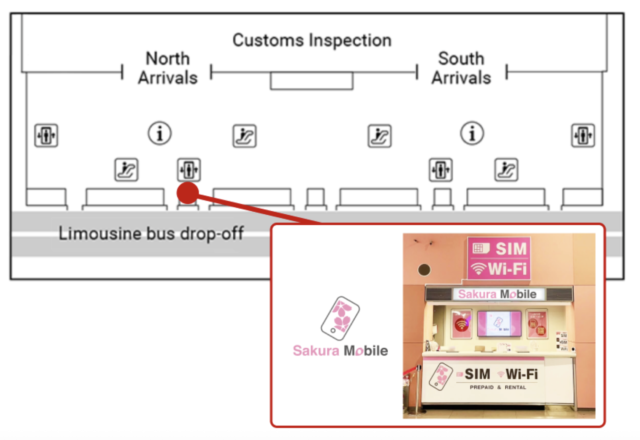
- Location:Terminal 1, 1F Arrival Lobby
- Hours:6:00 AM – 11:00 PM, every day
- Order online before your trip, compare plans in advance, and skip the line—just walk up to the counter after landing.
- Traveling through Terminal 2? Take the free shuttle bus over to pick up at the Terminal 1 counter.
What Makes Sakura Mobile Different?
- Full English Support—before, during, and after your trip
- Airport pickup at Kansai, Haneda, Narita, and Fukuoka
- Hotel delivery or eSIM options if you'd rather skip the counter altogether
- Flexible plans for short trips or long stays, with easy online top-ups
- Easy returns—drop your device in any Japanese mailbox with the provided envelope, no contract, no activation fee
FAQ
- Q: Which Osaka-area airport should I be flying into?
A: If you're arriving internationally, it's Kansai International Airport (KIX). Osaka Itami Airport (ITM)—formerly called "Osaka International Airport"—handles domestic flights only. Kobe Airport (UKB) is a smaller, mostly domestic option best for travelers based in Kobe.
- Q: What is Visit Japan Web, and do I need it?
A: It's a free government website that lets you submit immigration and customs information before you fly, giving you a QR code that can speed up your arrival at KIX. It's optional—paper forms are still accepted—but it can save time at a busy arrival.
- Q: Does Kansai Airport have free WiFi?
A: Yes. Both terminals offer free WiFi through the AirportFreeWiFi-Kansai network. Connect through your device’s WiFi settings and accept the terms of use—no sign-up required.
- Q: What mobile network does Sakura Mobile use?
A: It depends on the product: Sakura Mobile’s Pocket WiFi runs on docomo, while SIM cards and eSIMs run on either docomo or au—all reliable networks for both city and rural coverage.
- Q: Is there 5G coverage in Japan?
A: Yes, in most cities, including Osaka, Kyoto, and Kobe. Rural mountain areas may drop to 4G/LTE, which is still fast enough for maps and translation apps.
- Q: Is Kansai Airport’s Terminal 1 renovation finished?
A: Yes. The five-year renovation was completed on June 2, 2026, adding a new 2F international commercial area with 24 new shops and the Call to Gate system. This area is for departing passengers, not most international arrivals.
- Q: What terminal do low-cost carriers use at KIX?
A: Terminal 2. Airlines like Peach Aviation, Jetstar Japan, Spring Airlines, and Jeju Air all operate out of Terminal 2, which connects to Terminal 1 by a free shuttle bus.
- Q: What if I land after the last train or have a very early flight?
A: Aeroplaza, connected to Terminal 1, is open 24 hours with dining options and Hotel Nikko Kansai Airport on-site. It’s the easiest option if you’d rather not take a late-night taxi into the city.
- Q: How do I get from Kansai Airport to Osaka or Kyoto?
A: Options range from budget-friendly Nankai Airport Express (970 JPY to Namba) to the faster JR Haruka Express (3,990 JPY to Kyoto) or an Airport Limousine Bus if you’re carrying heavy luggage.
- Q: How much does a taxi from KIX to Osaka cost?
A: Expect roughly 16,000-25,000 JPY for the 50-70-minute ride into central Osaka—a reasonable option for late-night arrivals, groups, or heavy luggage, but pricier than trains or buses.
- Q: Where can I rent a Pocket WiFi or SIM card at KIX?
A: Sakura Mobile’s counter is in Terminal 1, 1F Arrival Lobby, open 6:00 AM – 11:00 PM daily. Ordering online before your trip lets you skip the line at pickup.
- Q: How do I get from Kansai Airport to Universal Studios Japan?
A: The easiest option is the direct Airport Limousine Bus from Terminal 1 (about 70 minutes, ¥1,600–1,800). Alternatively, take the train to Nishikujo Station and transfer to the JR Yumesaki Line for one stop to Universal City.